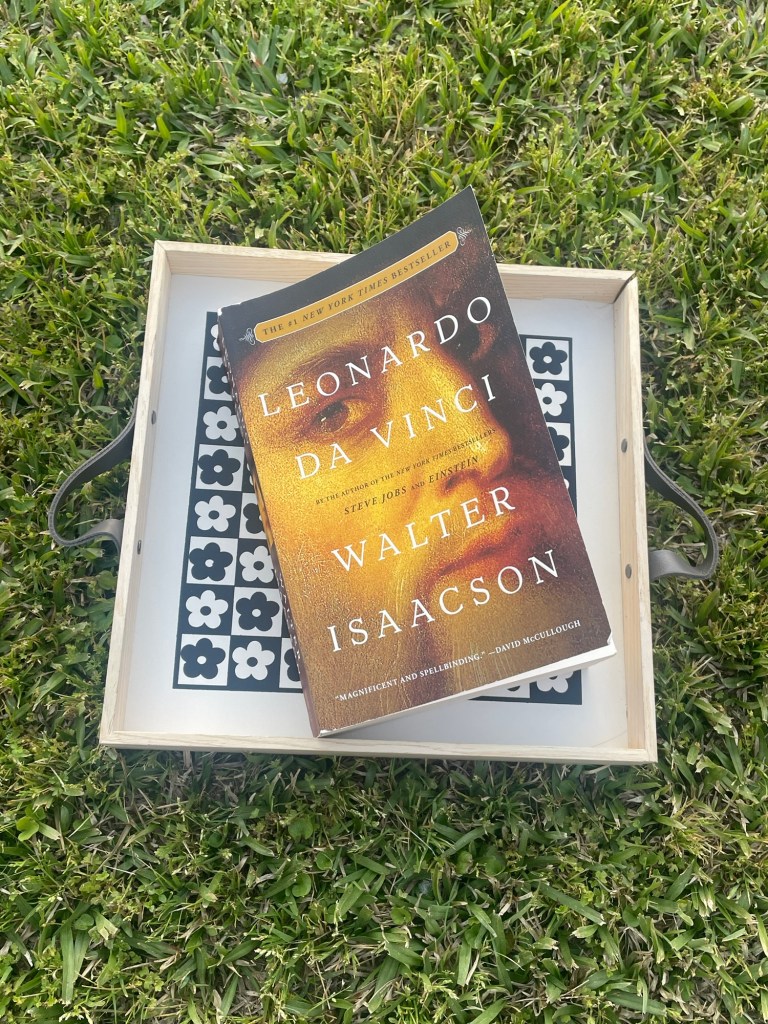
“Leonardo da Vinci” is a comprehensive exploration of the extraordinary polymath’s life, connecting his artistic masterpieces with scientific pursuits, showcasing how his curiosity and creativity made him history’s greatest genius.”
People like Leonardo da Vinci are the people who push our society forward even if they’re not trying to. It makes me wonder what the world would be like if we were all like that. Leonardo was unapologetically himself. That meant being gay , vegetarian, and even having some heretical views in a time when none of that was the norm. He didn’t care, he was just himself. I think that speaks a lot for who he is as a person and why he was able to do the things that he did.
A lot of ourselves consider ourselves to be artsy or technical, but Leonardo proves that you can be both. There is math and science in art and there is art and beauty in math and science. Everything is intertwined and that is what makes our world work and what makes us human. Leonardo did push society forward, but the author does say we need to be wary of calling somebody a genius. Sure, he had great creations like the Mona Lisa, and was inventing things like scuba diving and helicopters centuries before they actually came to be, but he wasn’t the perfect person. Again if he was, I don’t think we would have the greatness that he put out into the world.
Speaking of those inventions, it was so mind blowing to me all these things that he was coming up with,just out of pure curiosity, he never published these things in his life and other inventors came out with them centuries later, but we have all these notebooks, thousands of pages worth where Leonardo is coming up with these ideas in the renaissance. He truly had a remarkable mind and I think a lot of us will be able to find relatability in him because he was such a real person, and this really humanizes that figure of the legend Leonardo da Vinci.
The author did a tremendous amount of research in this book. There’s honestly such a long section of notes. Something that I did like was he poked fun at some early biographers of Leonardo da Vinci. This is something that I come to see while reading historical biographies. That a lot of time those early biographers were including fantasy as well trying to shape a certain image of the person they were writing about. However, I did have a hard time finding some of the facts that the author was using. Such as the family of the woman that inspired Mona Lisa and her connection to the Medici. I was not able to find that online, and I am very fascinated by the possible connection between her stepmother and Giuliano Medici.
I did enjoy the structure. That we didn’t reach Leonardo‘s most iconic work, the Mona Lisa, until the last three chapters of the book. It flowed very well and had that anticipation for that big ending. I even like that in the concluding chapter it’s all about what we can take away from this book and what we can learn from Leonardo da Vinci. To be more like him and therefore being better to society. This is an over 500 page book and it did take me nine days to get through, but I was never bored. There was constantly new knowledge being thrown at me. I will admit the author would analyze some of the paintings of Leonardo and that was kind of tedious for me. I do understand why we have that though because it helps us understand the artist as a person. Some other bits about engineering and anatomy or math,all of that did go over my head at times. There was something else that I found interesting about the writing style and that I’ve never seen in a biography before. That is the author would insert his own opinion on certain situations. I’m not exactly opposed to that, but it was something unique and as I said, I’ve never seen before.
This was a great book and I learned a lot. I knew the basics about Leonardo, but this really shows who he was as a person and maybe it will inspire all of you to keep a little notebook.
3.75 out of 5 stars.

 Izzy Reads