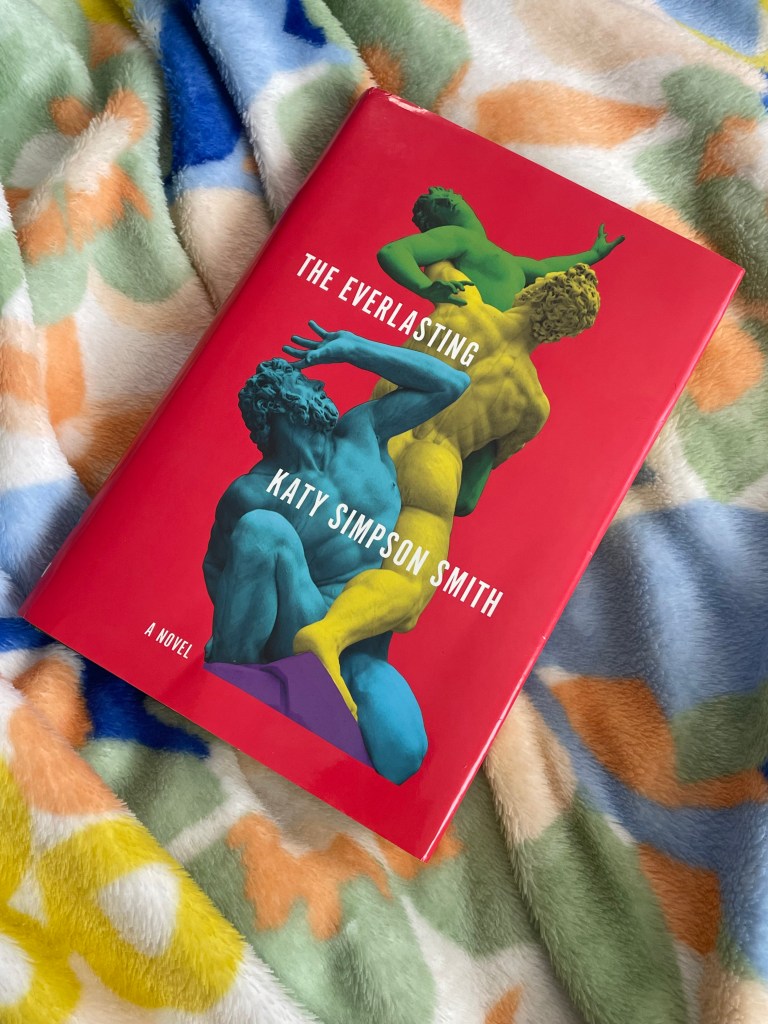
“The Everlasting by Katy Simpson Smith is a sweeping, multi-century exploration of love, faith, and moral struggle, set against the rich backdrop of Rome. The novel follows four distinct protagonists—Prisca, a 12-year-old early Christian martyr; Felix, a medieval monk tending crypts; Giulia de’ Medici, a pregnant princess of Moorish heritage; and Tom, a contemporary American biologist—each grappling with desires, duty, and sacrifice in their own time. Interwoven with their stories is an omnipresent, time-traveling Satan who offers ironic commentary, binding these narratives across two millennia. Poetic and ambitious, the book poses timeless questions about goodness, forgiveness, and what it means to love in a world marked by impermanence and history.”
Original review:
This is going to be a complicated but loving book review. As always, we will start first with the characters. This was really a mixed bag of characters, but I wouldn’t say I felt extremely connected to any of them. The child, Christian martyr, Prisca, was definitely my favorite character. I love seeing the world through the eyes of a child, especially in an adult book rather than a book that is geared towards children. I also liked the atmosphere that her story presented as we are seeing the early days of Christianity. The Medici princess, Giulia, believe it or not, was my least favorite character. I just didn’t like her. She seemed to think she was better than everyone, and I didn’t think the character work was there for her. The two male characters, the one in the ninth century and the modern-day character, were fine, no strong feelings.
I loved the atmosphere in the story. I always talk about how there is so much history on the Italian peninsula, and that is amplified in this book, showing it off spanning thousands of years. The author did it in such a unique way, selecting random times rather than doing a huge book following all the time (I would love both, but I do really like how the author did it). In this one, again, the second-century plot was my favorite. That one is so unique and one that I’ve never read before in literature.
The writing is where this gets complicated. The dialogue was lazy. The prose was dense and overbearing, but there were moments I had to take a picture of a page because it was so good, and I had to share it. Overall, though, the writing made me feel exhausted, and I almost fell asleep reading this book at times. I definitely think this would be better as an audiobook, and when I do reread this book, I will do it as an audiobook.
The plot was by far my favorite part. Our main theme in the story is love and how it comes in all different forms and how it’s different for every person, but that was not my favorite theme in the story. My favorite theme was history and how everything is connected. If you are a history lover, you have to pick up this book. I loved this book, but it is not a new favorite.
⅘ Stars. April 14-20, 2024
Review on reread in 2025:
This time around, I listened to the audiobook version of the book while also reading the physical copy. I annotated the book this time. The audiobook features a multi-cast narration, with different narrators for each point of view. This made the characters feel much more personable. I understood them a whole lot better—why they were the way they were, why they felt the way they did, and why they acted as they did. Each character is going through their own set of struggles, and one of the main themes here is love in all its different forms.
With each character, except for one who I’m really confused about, we see various expressions of love. First, we have Tom in 2015, who is having issues with his marriage but also shows the love of a father for his child. Then we have Giulia, the Medici princess, who is trying to find love for herself. Felix is the character I’m confused about; I can’t quite unravel what display of love he’s showing. It could be a combination of all these or something that I’m just not picking up on altogether. We also have Prisca, who demonstrates a love for God.
I did enjoy Felix a lot this time. I don’t know if he’s my favorite character, but Prisca was my favorite character the first time around, and I still find her story to be so moving. We also need to talk about the omnipresent character of Satan. Something I didn’t know when I got the physical copy is that in the audiobook, Satan is narrated as a woman, which has made me think about so many things. Satan is depicted as a bitter ex, with God being the ex-partner of Satan. This has made me reflect a lot on the plot of the book, and I feel like there’s some kind of feminist undertone to the story, though I’m not exactly sure what that is yet.
With the character of Satan, I realized how ever-present Satan is; while you have to build your relationship with God, Satan is always there off to the side, wanting to lure you off the cliff.
I absolutely loved the setting of Rome. We traverse 2,000 years of history, exploring all the different eras of the city. With the character of Satan, we also see glimpses of present and future events. If you’re someone who loves not just Roman history but history in general, then this is a book for you.
This leads me to the writing. The writing is beautiful. While it might not be my absolute favorite style, I can see how it could be a bit much at times for some people. I definitely recommend the audiobook to get a better understanding of the writing style and to be more immersed in the story. The writing is so thought-provoking, with beautiful instances of reflection on things I had never considered before regarding history. I had to get the highlighter out for this one!
The first time I read the book, I was really focused on the historical theme of the story. While I acknowledged other themes like love and loneliness, I was primarily drawn to the history. The title, ” The Everlasting,” reflects the frequent discussion of everlasting love—love that only God can provide—and how, as humans, we are constantly looking towards everything He created, looking for love when it ultimately comes from him. However, this theme of love also delves into the emotions that accompany it: the pain, the lust, and, as I mentioned with Satan, the lurking presence of love. To experience that pure love, you must build a relationship and nurture it.
As for loneliness, it wasn’t something I picked up on during my first reading, but I now see that all these characters are struggling with it. Loneliness and love often go hand-in-hand; you can feel lonely because you haven’t found love, lost love, or tried to find love but couldn’t.
Another thing I noticed is that ghosts are frequently mentioned, at least once in every point of view. This has me questioning whether there are ghosts of other characters lurking in the perspectives of others. Additionally, learning more about the character of Satan this time around, especially with Satan taking a personified form in the chapters, has really blown my mind.
The intrigue was strong, and I actually didn’t remember much from my first reading; I just recalled the very basics. I don’t think there was a logical conclusion to the story—for Prisca’s story, perhaps, but for everyone else, it feels very open-ended and leaves me wanting more resolution. However, I do think this is an epic story, and lately, I’ve been questioning how a book that’s only about 300 pages can be epic. This book has confirmed for me that it is indeed possible. I loved this book even more than when I read it the first time, which speaks to the power of rereading and switching formats. Yes, I would definitely recommend that you pick it up!
4.25 out of 5 stars


 Izzy Reads