‘Leviathan Wakes’ Book Review

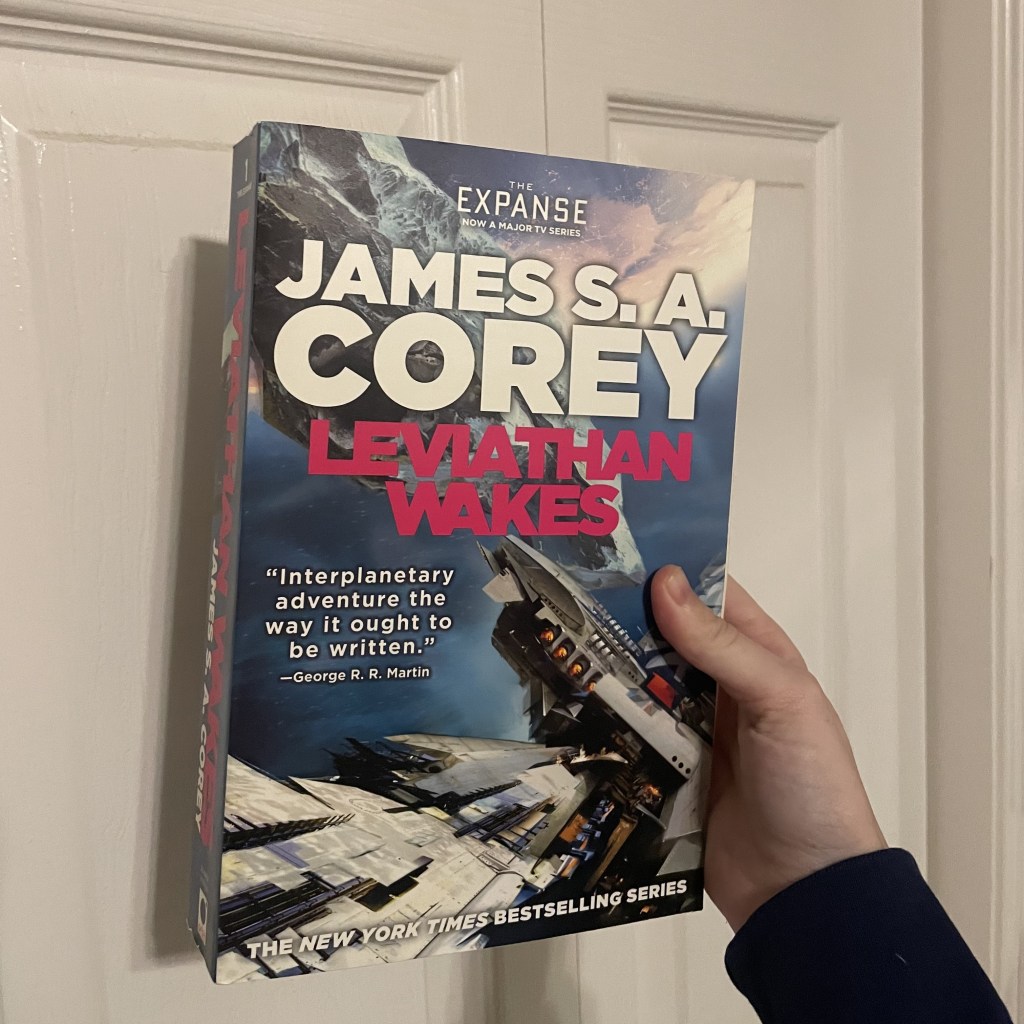
Leviathan Wakes by James S.A. Corey is the first book in The Expanse series, blending space opera with noir detective fiction. Set in a future where humanity has colonized the Solar System, the story follows two main characters: James Holden, the idealistic executive officer of the ice hauler Canterbury, and Detective Joe Miller, a grizzled investigator on Ceres Station.”

This is not a character-driven story for half the book; that’s such an odd statement that I’ve never really had to write for a review. The chapters with Holden as the main character are plot-driven, while our chapters with Miller are character-driven. Let me explain: with James Holden, when we are introduced to his plotline, we are introduced to his whole crew all at once. For me, that is extremely overwhelming to be introduced to a handful of characters within a few pages of each other. It’s especially bad when the majority, if not all, of those characters do not develop throughout the course of a nearly 500-page book. Miller is like a lone wolf, so you’re really in his head a lot, and I think the depiction of mental health and PTSD was done fantastically in this book, as it’s something that you see a lack of in science fiction and fantasy genres, even though these characters are going through really messed-up and war-like situations. I do want to say you can definitely tell that this book was written by men, as all the female characters are there for the sake of the males having some sort of romance. You could still have that Phoebe plot without the romance and there was no chemistry between Holden on his love interest. That guy was falling for every woman. I hate to have to write that, but I couldn’t help but pick up on that throughout the book, and I just know some men are going to be offended by that comment. Sorry, not sorry.

The universe said this was sudden, which was super cool. This isn’t some make-believe galaxy; this is the galaxy that we are living in right now as humans. The author does take into account science and how gravity, or the lack thereof, impacts people’s bodies. Of course, that’s going to lead to all sorts of things like xenophobia and racism, even though we are in outer space and not on Earth.

I have no real complaints about the writing. It didn’t impact my reading experience one way or another. There were some cringey lines every now and then, but I do have to remember that this book was published 14 years ago, and some of those lines might have passed back then.

I do like the idea of the plot, how this is genre-bending, as this is a mystery noir story set in a sci-fi environment; it is definitely something unique. There’s one problem, though: I was confused throughout, especially in the second half of the book. We would get a lot of science and physics talk at once, and a lot of that went right over my head. I also spoke about the characters, and for half the book, we didn’t have a whole lot of character development, if any at all. If I do not connect with the characters as a reader, I’m not going to care about what is happening in the plot, and by the last chapters of the book, all of it felt kind of pointless to me. I can admit there was a lot of logic for the science, but with other aspects, I think there was a lack. I didn’t really care where the story went, and as you can tell, I will not be continuing the series. This year for my TBR, I am making a list of the highest-rated books on my TBR, and this is the highest-rated science fiction book according to Goodreads that I own. Now I’m kind of scared of this challenge that I’ve set up for myself. This book didn’t do a whole lot for me. I wouldn’t really recommend it, but as always, if this sounds intriguing to you, pick it up, but maybe try from the library first.

2.25 out of 5 stars.

‘The Alienist’ Book Review

The Alienist by Caleb Carr is a historical crime thriller set in 1896 New York City. It follows Dr. Laszlo Kreizler, a psychologist (referred to as an “alienist” in that era), and his team, which includes reporter John Schuyler Moore and Sara Howard, one of the city’s first female detectives. They are enlisted by then-Police Commissioner Theodore Roosevelt to track down a brutal serial killer preying on young male prostitutes. Using emerging techniques like psychological profiling and forensic science, the group delves into the mind of the killer, uncovering dark secrets while facing resistance from corrupt officials and society. The novel explores themes of mental illness, morality, and the complexities of justice.

This is a book that I think would benefit more from being told in the third-person perspective than in the first-person perspective. Usually, when you are telling the story from the first-person perspective, you can really feel a connection to the character, but here it was the complete opposite. I felt absolutely nothing towards the main character. I saw another review refer to John Moore as an observer, and I think that’s the perfect way to put it rather than him being a player in this plot. All of the characters were developed. This is one of the most developed casts of characters I’ve seen, but again, I did not feel a connection towards these people.

Atmosphere is definitely one of the highlights. I loved that we are in New York City, a city that is still in a way similar because the street names are the same. The neighborhoods are in relatively the same locations, so you have an idea of what the modern place looks like, but then put all the smog and dirt on top of that and you’re going to have your 1896 setting. There was so much research put into the setting and getting those exact street names and those exact locations. It was so easy to picture. This book was full of descriptions.

The writing was very descriptive, as I said. I never felt bogged down, though, or that it was too much or over the top. The chapters were relatively short for the most part; only a handful went on a bit too long. In those chapters that did go on so long, I have no idea how the author expects us to remember every bit of dialogue that went on. However, this book did go by relatively fast, even though it was 600 pages, but the short chapters were a lifesaver.

I’m not really a thriller person, but I did find this book to be extremely interesting. It was incredibly logical; there were no loose ends, and everything was happening for a reason, rather than for shock value. This is the deepest thriller I’ve ever read. It may be the smartest thriller I’ve ever read. There’s so much depth to the story. One of the main themes here is that people are complex. There is context to why a person is the way they are—a person isn’t just born being a killer or being evil. Things lead up to them being the way that they are, things that usually happened in their childhood. This book really shows what makes a killer. Those are great themes, and there is so much logic throughout the 600 pages, but it was lacking intrigue. I found myself getting bored and just not caring. Overall, this is still a good book. There’s a lot of depth, and it was smart. I would recommend picking it up if you’re interested.

3.5 out of 5 stars.

‘Uncle Paul’ Book Review

“Uncle Paul” by Celia Fremlin is a psychological thriller that delves into the tangled relationships of family dynamics, fear, and paranoia. The story revolves around Meg, a woman who finds herself swept up in unsettling events when she joins her two sisters, Isabel and Mildred, at a seaside cottage for a vacation. However, this holiday is far from restful as they are haunted by the shadow of “Uncle Paul,” Isabel’s estranged and possibly dangerous ex-husband, who seems to be drawing closer.

These characters did nothing for me. Yes, I could tell them all apart. They all had a little bit of dimension to them, but I didn’t care about them. I didn’t care what was happening to them. I didn’t care about their stories. That tends to be true with thrillers or mysteries — there’s not a whole lot to the characters, and there is more focus on the plot in the story, but that’s not even the case with this book.

As for the atmosphere, the 1950s setting does come across strongly, as this book was first published in 1958. I never felt scared, but I wouldn’t say this was a cozy atmosphere either. This is a good transitional piece, going from summer to fall, as the book takes place in a seaside town in the month of August.

The writing was definitely the best part. There are some sentences that are really good. It is fast-paced and easy to read. If you’re scared to pick up a book that came out over half a century ago, don’t be for this one. It reads incredibly modern in terms of the writing style.

The plot is where I was incredibly bored. I feel like so much of this book was just pointless. As I said, this is a thriller, but I never felt thrilled. There was intrigue, and I was wanting to know what the wrap-up of the mystery was going to be. I found this book lacking a lot of logic. I would not recommend picking up Uncle Paul by Celia Fremlin.

2.25 out of 5 stars.

‘Horse’ Book Review

“Horse” by Geraldine Brooks is a historical novel that intertwines multiple narratives across different time periods, centering around the life of a remarkable thoroughbred racehorse named Lexington. The story explores themes of art, history, and the bond between humans and animals, particularly through the perspectives of various characters, including a 19th-century painter, a contemporary art curator, and a young Black man in the present day. Through the lens of Lexington’s legacy, Brooks delves into issues of race, class, and the complexities of love and ambition, ultimately showcasing how the past continues to shape the present. The novel highlights the intersection of personal and collective histories, revealing deeper truths about society and the human experience.

These characters could have been so much more. We are first introduced to our characters in the modern plotline in 2019. They really didn’t bring anything new to me. Yes, they are interesting roles, as one is a scientist at the Smithsonian and the other is a PhD student. However, there is a lack of emotional connection to these characters, and I found them to be quite irritating by the time the novel is over. As for the historical characters, I really wish the bond between man and animal, specifically between Jarrett and Lexington, had been deeper; there would’ve been more depth there. Again, it lacked emotional connection.

I did really enjoy the atmosphere of going through all these different time periods, with our main focus being the ones in the 1800s and then in 2019. You can really tell that the author did her research on the locations and historical figures involved. I don’t have anything strong to say about the writing; it was fine, but this was incredibly slow to get through, making it a very slow-paced book.

I love the idea of this plot, how all the storylines across centuries are connected to one another. They’re all linked by this one horse, one of the greatest racehorses of all time. How could an author screw that up? Well, they managed to create a slow-paced and boring book with characters lacking emotional depth. My favorite plotline was personally the one about how the painting was connected to the story. However, this is the one that we saw the least of on the page. As I stated before, the slowness really made me bored, and the book was lacking intrigue. I have to mention that the last 50 pages of this book are so bizarre; the author really wants to hone in on our current times of police brutality and COVID. Those are important topics and do need to be addressed in fiction, but I don’t think this book was the place to do it. This was a fine book, but it was overall lacking in many categories and did not live up to my five-star expectations of it.

3 out of 5 stars.

‘Demon Copperhead’ Book Review

“Demon Copperhead” is a novel by Barbara Kingsolver, published in 2022. It’s a modern retelling of Charles Dickens’ classic “David Copperfield,” set in the Appalachian Mountains of Virginia. The story follows the life of Damon Fields, nicknamed Demon Copperhead, as he navigates the hardships of poverty, addiction, and the foster care system in rural America.

Demon is one of those characters that I didn’t realize how much they meant to me until the madness starts when things start hitting the fan, and you can’t help but feel emotions coming over you. Every character introduced in the story had meaning or purpose, and all their stories tied together; there were no loose ends. Every action had consequence and purpose for the story. Demon has a constant battle within himself: is he a good or bad person? Is he Demon, or is he Damon? We truly go on a journey with this character, and I could not help but feel every single emotion while reading. There were moments of despair where I just felt depressed after reading a quarter of the book; I truly had no idea where his story was going to go. This book always had me guessing, and I was gripped by the character arcs.

The atmosphere was amazing, and I think one of the main themes you are shown is what life in Appalachia is like. I can attest that this is what small-town rural life is like. I almost believe this is one of those novels where the atmosphere of Appalachia is a character in itself. The writing was very picturesque, and it was very easy to imagine the scenes.

That leads us to talking about writing. This wasn’t my typical go-to for writing; it wasn’t poetic, but as I said, it was picturesque, and I was highlighting so many quotes. We have Damon looking back at his life, and obviously, going through so much in that time, he’s going to gain wisdom from that, and there was wisdom throughout these pages.

There are so many themes, but as I said, I think the main theme is showing what life in Appalachia is like, and how so many things like the pharmaceutical business, coal mining, and even Hollywood have corrupted Appalachia and its people. This book was so eye-opening to just the underbelly of it all. Another thing that I would like to add is that this book doesn’t just show one traumatic event after another. Life isn’t just straight-up bad or good. Yes, Demon is going through all these terrible things, but there are happy moments as well. This book doesn’t just focus on the bad but shows how life is just plain confusing with all that it throws at you. I cannot say enough about how eye-opening it was. How gritty it was. How raw it was. This book needs to be read by all. A five-star prediction that lived up to it.

5 out of 5 stars.

‘In the Beginning was the Sea’ Book Review

“”In the Beginning Was the Sea” by Tomás González is a haunting and evocative novel set in the turbulent 1970s of Colombia. It tells the story of J. and Elena, a young urban couple who abandon their comfortable city life in Medellín to pursue an idealistic dream of living off the land on a remote Caribbean island. They purchase a rundown farm with plans to create a self-sustaining paradise, but soon find themselves confronted by the harsh realities of rural life, isolation, and the unforgiving natural environment.

As their utopian vision unravels, tensions rise, and their relationship deteriorates under the strain. The novel explores themes of disillusionment, the clash between idealism and reality, and the destructive consequences of human ambition. González’s lyrical prose vividly captures the lush yet perilous landscape, drawing readers into a deeply atmospheric and morally complex tale. “In the Beginning Was the Sea” is a profound meditation on human nature, the fragility of dreams, and the inexorable force of nature.”

The characters are an interesting piece of this novel. We can understand why things don’t go as planned for them as they leave the city to live off the land. A lot of their feelings are left up to interpretation for the reader to understand. We can make assumptions about why they feel this way: Elena leaving behind everything she ever knew makes her miserable, and then J., having to be around a miserable person, finds his life becoming a mess. Again, we can only assume all of this.

If you were a fan of the atmosphere in ‘Mustique Island,’ then you will be a fan of this Colombian island. The atmosphere was lush, and the imagery along with its metaphors hit the spot! There was also an ominous and mysterious feeling in the first quarter of the novel that made the story gripping.

The writing was atmospheric, which I loved. It was filled with imagery and metaphors, making it fast-paced and easy to devour.

The plot is a hidden gem in my eyes. We have our straightforward plot: two city people leave the city to live off the land on a tropical island, and things don’t go as planned. However, the hidden theme is about leaving capitalism and modern society behind and whether you can truly do it. It’s about leaving this society behind and living the way humans were intended to. It’s a lot to think about. Again, these were just my observations, and it could simply be about picking apart the impact such a move can have on a relationship. I was gripped throughout the story, and the plot moved in a logical manner.

The characters are an interesting piece of this novel.We can make assumptions about why they feel this way: Elena leaving behind everything she ever knew makes her miserable, and then J., having to be around a miserable person, finds his life becoming a mess. If you were a fan of the atmosphere in ‘Mustique Island,’ then you will be a fan of this Colombian island.There was also an ominous and mysterious feeling in the first quarter of the novel that made the story gripping.The writing was atmospheric, which I loved. It was filled with imagery and metaphors, making it fast-paced and easy to devour. The plot is a hidden gem in my eyes. I was gripped throughout the story, and the plot moved in a logical manner. This was a good book and I would recommend picking it up if you are interested to do so.

3.25 out of 5 stars.

‘Our Missing Hearts’ Book Review

“”Our Missing Hearts” by Celeste Ng is a compelling dystopian novel set in a near-future America where cultural and political repression is the norm. The story revolves around twelve-year-old Bird Gardner, who lives with his father after his mother, a Chinese American poet named Margaret, has disappeared under mysterious circumstances. In a society where children of dissidents are relocated, and anti-Asian sentiment is rampant, Bird embarks on a quest to find his mother, guided by a cryptic letter and fragments of her poetry.”

I did not have strong feelings towards the characters of ‘Our Missing Hearts.’ The author did not hit the nail on the head with the development of these characters. A lot of their development did not add up or was plainly hypocritical in a way that was not meant to be. Many of the plot points surrounding characters such as twelve-year-old Bird were unbelievable. Yes, this is a dystopian piece of fiction, but that just adds to the question of why some of these things were allowed to happen in a world so bad and dangerous. Poorly written character arcs.

The atmosphere of the novel felt like a true classic dystopian book in the vein of Bradbury and Orwell. The world was probably my favorite part of the story. At first, I thought this was set after some big cataclysmic event, but I would describe it more as 2020 on steroids. (If you were there, you will understand.) The author did a great job with the world-building, explaining why things were the way they were in this world that was almost like ours.

The most average part of the book was the writing. You can definitely see that Ng was trying to make this poetic, but it was overall just fine for me. I highlighted about three quotes or paragraphs that I thought were good enough to hang onto.

Now, this plot is extremely fascinating but overall fell flat for me. “Flat” is the word that I would use to describe my reading experience for Our Missing Hearts. It was predictable and, as I stated before, the journey of Bird was pretty much unbelievable. I do think this plot is a good comparison to our world today and how many people view conflicts or protests happening around the world. This book could have had a much greater emotional impact and been more gripping, but sadly, it fell flat.

I did not have strong feelings towards the characters of ‘Our Missing Hearts.’ Poorly written character arcs. The atmosphere of the novel felt like a true classic dystopian book in the vein of Bradbury and Orwell. The author did a great job with the world-building, explaining why things were the way they were in this world that was almost like ours. The most average part of the book was the writing. I highlighted about three quotes or paragraphs that I thought were good enough to hang onto. Now, this plot is extremely fascinating but overall fell flat for me.This book could have had a much greater emotional impact and been more gripping, but sadly, it fell flat. I wish that this story would have had the character work that was involved in ‘Little Fires Everywhere’ by this same author and maybe, just maybe, it would have made the story for me. This was an average read.

3 out of 5 stars.

‘People Person’ Book Review

“She’s thirty, and her life isn’t really going anywhere. An aspiring lifestyle influencer with a wayward boyfriend, Dimple’s life has shrunk to the size of a phone screen. And despite a small but loyal following, she’s never felt more alone in her life. That is, until a dramatic event brings her half-siblings—Nikisha, Danny, Lizzie, and Prynce—crashing back into her life. And when they’re all forced to reconnect with Cyril Pennington, the absent father they never really knew, things get even more complicated.”

You can find something relatable in each of the Pennington siblings. That is about the extent it went for me. They were pretty two-dimensional. They had these traits — too nice, rude, or sensitive. Yes, it does make sense for them to have a bad trait, but there was just not enough building into these characters. A lot of times with Dimple, her actions did not add up with who she was as a person. The characters are aware of who they are as people, but it was not an enjoyable reading experience with them.

The atmosphere of South London was a new experience for me, with a few public locations that I have become aware of from other books. I did enjoy exploring this new area and seeing how the atmosphere impacted the upbringing of our characters, the Penningtons.

I really struggled with the writing when I first sat down to read the ebook. I added in the audiobook to read along with at 13%. The writing just did not grip me, and it was taking me a long time to get through without the help of a narrator. My one positive about the writing, though, is that the dialogue was quite comedic in a dark sense of humor way.

The plot did not go how I expected at all. Yes, I knew the characters would somehow have to get together to build their relationships, but the author took it in a whole different route than one usually would. It was funny. Again, I don’t know why I was not fully gripped or intrigued. The plot could have been better if the characters were better.

You can find something relatable in each of the Pennington siblings. The characters are aware of who they are as people, but it was not an enjoyable reading experience with them. I did enjoy exploring this new area and seeing how the atmosphere impacted the upbringing of our characters, the Penningtons. I really struggled with the writing when I first sat down to read the ebook. My one positive about the writing, though, is that the dialogue was quite comedic in a dark sense of humor way. The plot did not go how I expected at all. The plot could have been better if the characters were better. This book did nothing for me; I didn’t like it, but I did not hate it either.

2 out of 5 stars.

‘Normal People’ Book Review

“”Normal People” by Sally Rooney follows the intricate relationship between Connell and Marianne as they navigate through adolescence into adulthood. Connell is a popular athlete while Marianne is an aloof and intelligent loner. Despite their differences, they form a deep connection that persists through various stages of their lives. Set in Ireland, the novel explores themes of love, class, power dynamics, and the complexities of human relationships. Rooney’s insightful prose delves into the intricacies of emotional intimacy, making “Normal People” a compelling and deeply affecting read.”

The characters are the highlight of the novel, which one would hope for when a word like “people” is used in the title. Marianne started out as my favorite; she was not a perfect character, and the flaws of the characters do seem to be a main part of the novel. Marianne was what I thought of myself or wished that I was in high school. Connell had some red flags for me, but nothing too serious. Throughout the course of the book, my thoughts on characters would take a 180-degree turn, seeing how someone can change at different stages in their life. That being said, the characters did develop in this story. I loved exploring the dynamics of the relationship of our two main characters but also how they interacted with other people in their lives like parents, siblings, lovers, or friends.

It was a shock that the atmosphere did not play a huge part in the novel. I say this as most Irish authors or books that I have read really take advantage of that setting. I cannot say that it completely did nothing for me as there were some paragraphs that really hit the nail on the head with descriptive writing on the atmosphere in which the scene was taking place.

The prose itself was great. I have seen some people having an issue with the lack of quotation marks, but with this book itself, that did not bother me. The story did move at a fast pace even if there were long chapters and paragraphs. I usually hate those things, but the fast pace made it a better reading experience. However, I do think this could have been condensed a lot, even though the paperback copy is less than 300 pages in length.

This was obviously a character-driven book. The plot was a quiet one as we were mainly exploring the relationship of Connell and Marianne. After the first quarter of the book, the plot did start to go into circles of repetitiveness. Again, this would not have happened if the story had been condensed. I will say, ‘Normal People’, did do something that no book has done to me before. I was reading a chapter and expecting to turn the page to the next chapter. The next page was the acknowledgements. That had me shocked. Take that as you will.

The characters are the highlight of the novel, which one would hope for when a word like “people” is used in the title. I loved exploring the dynamics of the relationship between our two main characters and also how they interacted with other people in their lives like parents, siblings, lovers, or friends. It was a shock that the atmosphere did not play a huge part in the novel. I cannot say that it completely did nothing for me as there were some paragraphs that really hit the nail on the head with descriptive writing on the atmosphere in which the scene was taking place. The prose itself was great. However, I do think this could have been condensed a lot, even though the paperback copy is less than 300 pages in length. This was obviously a character-driven book. After the first quarter of the book, the plot did start to go into circles of repetitiveness. This was a great book and I would recommend it to others, but it is not an all-time favorite.

4 out of 5 stars.

‘The Four Winds’ Book Review

“In this uncertain and dangerous time, Elsa Martinelli—like so many of her neighbors—must make an agonizing choice: fight for the land she loves or go west, to California, in search of a better life. The Four Winds is an indelible portrait of America and the American Dream, as seen through the eyes of one indomitable woman whose courage and sacrifice will come to define a generation.”

Elsa is the strongest character that I have read in a while. Her character development and journey were fantastically done. In the earlier parts of the book, she was so relatable. I am honestly stunned and left with not a lot of words as I sit here and think of the journey we went on with her character. However, there was one character who ruined the whole book for me: Loreda. When she was first introduced in the story, she was fine; I had no strong feelings towards her. As the book progressed, she only displayed negative traits. Sure, she was courageous and determined, but the bad outweighed the good here. I felt angry reading from her perspective and seeing her make things even harder for herself. In Hannah’s previous works, they left me with a gut punch. ‘The Nightingale’ was the first ever book to make me cry and also an all-time favorite book. This one, while the journeys of the characters did make me feel slightly emotional, was nothing like her previous works.

At first, I did not notice how great the atmosphere of ‘The Four Winds’ was, not until my friend pointed it out to me. The atmosphere of this book is literally hell. The scenes of the Dust Bowl left me feeling anxious and claustrophobic. When we got to the Great Depression, it left me with a feeling of despair.

The writing is what I don’t have a lot to say about. Its style or prose was just average. I had no feeling towards that aspect whatsoever.

There were so many themes presented in this novel, and they are another reason that I loved it. There is the theme of motherhood and the instincts that come along with that role. I even think this book is relevant in comparison to the modern-day border crisis. The way that so many people dehumanize immigrants, it’s awful, and this book really made me realize that even more. The main theme here is dreams: the American dream and all its variations. We see that dream in the sense of Hollywood and New York City, wanting a life like the stars. Other characters dream of basic things like love and family, things we need in life. Even more, like the Martinellis, they dream of having a better life in America than they did in Sicily, for their son and grandchildren to have the opportunities that they didn’t, like going to school. This is such a thought-provoking and reflective book. It would be a great choice for a book club so that the readers can discuss the themes.

This one, the journeys of the characters did make me feel slightly emotional but nothing like her previous works did.  At first, I did not notice how great the atmosphere of ‘The Four Winds’ was, not until my friend pointed it out to me.  Its style or prose was just average.  It would be a great choice for a book club so that the readers can discuss the themes. I loved this book but it will not be an all time favorite for me like the other works of this author.

3.85 out of 5 stars.