‘Displacement’ Book Review

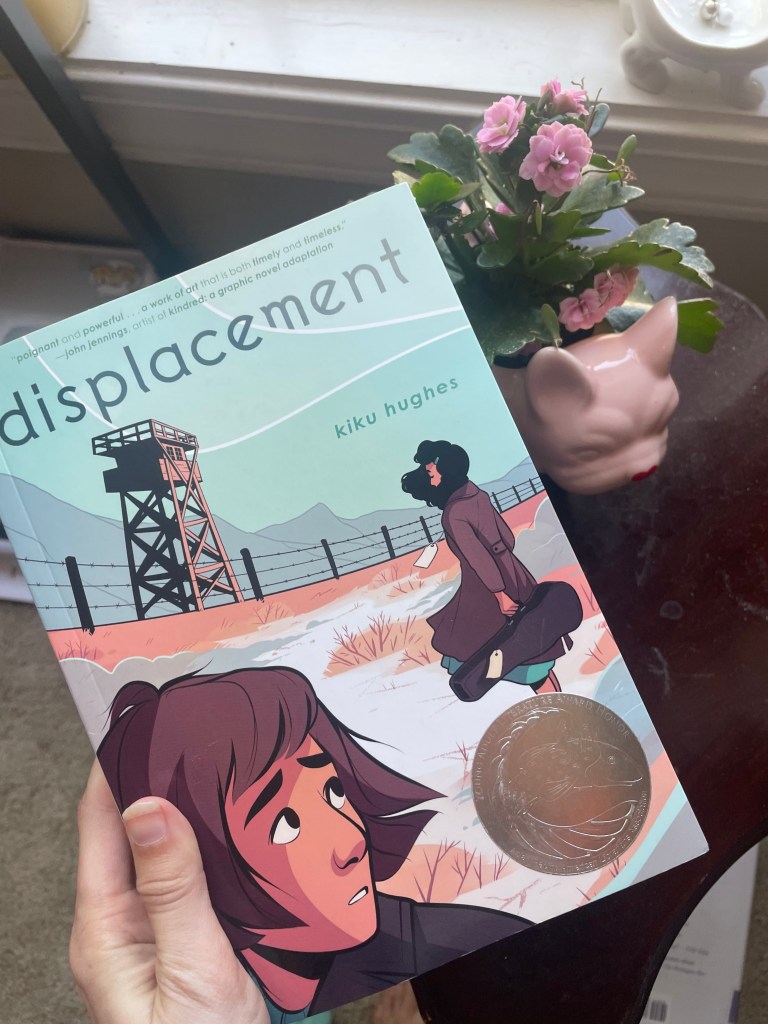
” “Displacement” by Kiku Hughes is a poignant graphic novel that intertwines the story of a modern-day Japanese American girl, Kiku, with the historical context of Japanese internment during World War II. When Kiku is transported back in time to a Japanese internment camp, she grapples with her family’s past and the trauma of displacement faced by her ancestors. Through her journey, she experiences the harsh realities of life in the camps, the impact of racism, and the struggle for identity, ultimately reflecting on the importance of remembering history and understanding the ongoing effects of systemic injustice. The narrative blends personal and collective memory, highlighting themes of resilience, belonging, and the fight against erasure.”

Each month, I like to add a graphic novel to my TBR, and this month it is ‘Displacement’ by Kiku Hughes. As a child, I read a ‘Dear America’ book on Japanese internment camps in the American West, but I haven’t read anything on it since. This is another work of young adult fiction that mixes fact and fiction. I love seeing these bits of history told in various forms—whether for adults, young adults, graphic novels, or memoirs. I think it’s so important to present history in as many formats as possible so it can be accessible to everyone.

The time travel elements are reminiscent of ‘Kindred’ by Octavia E. Butler, as we have a character going back for a little bit every now and then. It also reminds me of ‘One Italian Summer’ by Rebecca Serle, as we see our main character visiting a family member in the past when they were young. The big theme here is the importance of being educated on history, as history tends to repeat itself. These internment camps really need to be discussed more. I previously read about this subject, and we learned about it in school, but it needs to be more widely addressed.

World War II fiction is extremely popular, but it often focuses mainly on the European front. I believe the stories of Japanese Americans need to be spoken about more, as they endured significant injustices at the hands of the American government simply because of their ancestral background. I thought it was clever to use time travel in this book because Kiku is displaced from 2016 back to the 1940s, while the people of that time are being displaced from their lives and sent to these camps. Both have experienced displacement.

The author used this time travel element to cover gaps in her knowledge of her grandmother’s story. I do wish the glossary had been at the front of the book, as there were some terms I wasn’t familiar with, and I discovered the glossary was at the very back but once I had finished the book. One theme I found interesting was the struggle between trying to survive and doing the right thing, and how hard that choice can be. A quote that really captures this book is, “A memory is too powerful a weapon.” We have to remember history and how it shaped us because it tells the story of where humanity comes from and where it will go.

There were also things I had never heard of that I learned about in this book, like how Japanese Americans were portrayed as a model minority during the civil rights movement. Who knew that people in power were trying to pit other minorities against each other and spread anti-Black racism? This wasn’t the only time that camps were discussed in American history; while we hear about them today, back in the 70s, there were rumors and efforts to start camps to detain communists or Black Panthers.

I’d like to end with two more quotes. The first is, “Rumors start when there’s fear and a lack of information, and they still influence our memories forever.” The second is, “Never again is now.” So many times, we hear people say that we won’t allow things like concentration camps to happen again, but we really need to hold true to that as history progresses. This was a good book, and if you want to learn more about this time in American history and these atrocities, I recommend that you pick it up.

‘The Women’ Book Review

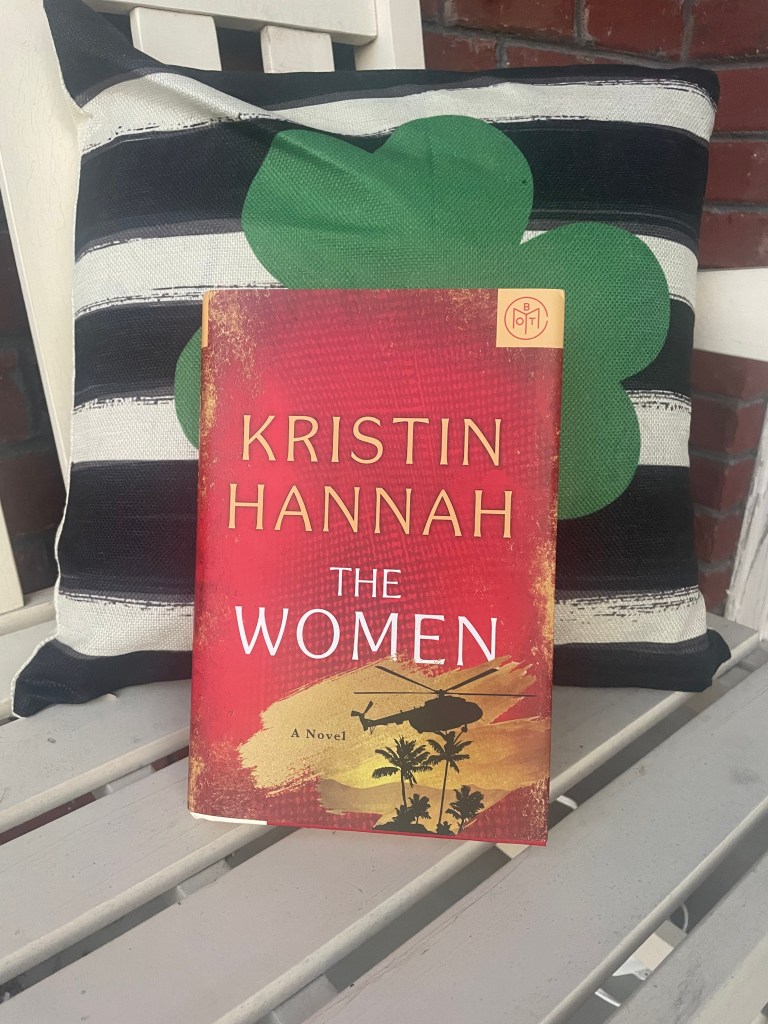
The Women by Kristin Hannah is a historical fiction novel that follows Frances “Frankie” McGrath, a young nurse from a privileged background who volunteers to serve in the Vietnam War. Amidst the chaos and brutality of the conflict, Frankie matures into a skilled operating room nurse, facing the harrowing realities of war. Upon returning home, she encounters a society unprepared to acknowledge the contributions and sacrifices of female veterans, leading her to struggle with reintegration and seek recognition for the women who served. The novel delves into themes of heroism, gender roles, and the often-overlooked experiences of women in wartime.”

Any and all bad things happened to our main character, Frankie McGrath. It was trauma galore. Let me tell you what she went through as a character. Frankie follows her older brother to Vietnam. She is a nurse, and at first, she’s very meek and scared of the role of a combat nurse and being at war. A traumatic event happens to a friend that awakens something in Frankie, and suddenly she is passionate and determined to get her job done in Vietnam. She realizes that she is making a difference in many people’s lives. Her tour of duty then comes to an end, and she returns to America. She’s angry, and there are so many emotions inside of her. The book then unravels all those emotions and what comes with them. Now, doesn’t that sound like a great book? It does! However, believe it or not, Kristin Hannah did not properly execute this character arc. I am honestly amazed that Hannah was the one to write this character’s story. I felt angry reading this; that middle part of the book when Frankie returns to the United States had me raging after I read it. I truly felt the emotions that Frankie was feeling, but not in a good way, as I was feeling them directed towards her. I am well aware of what war can do to a person—not from firsthand experience, but from reading and hearing other people’s stories and experiences. Frankie’s story makes complete sense of why she felt the way that she felt, but the way it was written was awful. There was a lot of telling us that Frankie felt these feelings, but not showing us. There was no real flow in how her character developed. It was all very sudden. Frankie might be one of my least favorite characters I’ve read about in 2025. She was a Mary Sue. Let’s talk about her character connections. I really could feel the chemistry between her and her romantic interests. I really loved the character of Jamie. Now, this book is called “The Women,” and women play a big part in the story. However, I didn’t feel any connection between her and her so-called best friends. There were also a lot of contradictions in those female friendships. I can appreciate that there was never any competitiveness between women in this book, and I am really happy about that, but I could not feel the connection between Frankie and her friends—only between her and her romantic partners.

Kristin Hannah is great at painting a picture in the reader’s head and dropping the reader into that landscape. I could easily picture the jungles of Vietnam, the beaches along the South China Sea, and the all-American vibes of Coronado and San Diego, as well as the more rural scenes throughout the United States. Great visuals create atmosphere, and this is also the most well-researched book I’ve read that takes place in the 1960s and 70s.

The author’s writing style may not be my favorite, but it’s still great. As I said, she does a fantastic job of creating a vivid setting. This book is nearly 500 pages, and I read it in four days. It was so fast to get through, and the plot moves at such an organic pace. I never felt bogged down, nor did I feel rushed through the story. The pacing was fantastic, and I love that because it’s something I struggled with in books like “The Nightingale.” I can definitely see improvement from her earlier historical works in this one regarding the writing style.

The plot is definitely the best thing about this book. As I mentioned earlier, the character journey is amazing; it just wasn’t executed properly. Again, I talked about how incredibly well-researched this book is. I love the research that Kristin Hannah put into it. She had the idea of writing this book all the way back in 1997, but at the time, she didn’t feel mature or equipped enough to write it. She did the right thing by keeping that idea locked in her head and waiting for the right time to write it out. I honestly respect that so much. This book paints the perfect picture of what America was like at that time and the unraveling of the American dream that was instilled in our minds back in World War II and the 1950s. People were beginning to realize that their government might not really care about them, and things might not be exactly as they seemed. 

We see all different sides of the political spectrum in this book, from conservative parents to radical best friends, patriotism, and whatever the opposite of that is. In many books about this time, you see people protesting, but I don’t think the authors really understood what they were writing. They just wanted to include that because, when people think of this time, they picture individuals with signs in Washington, D.C., and San Francisco. They don’t really realize what these people were trying to say. I love that you see all different kinds of people who are protesting: some who are not well-informed and others who are actually intelligent. 

One of the great things about historical fiction is relating it to the modern day. I think this time in history is one of the most reminiscent of what we are going through right now. There are going to be so many quotes in here about division that you can’t help but relate to the 2020s. I believe this book will be a big eye-opener for a lot of people regarding what the Vietnam War was like. This wasn’t that long ago, and there were so many instances of things I’ve heard about from family members—things they remember from that time. I got to see it on the page, and that was so cool, getting to see scenes written out of stories I had heard from my own family. 

This book showed what a huge impact the Vietnam War had on America and things that I never realized were caused by this war. A huge theme here is remembrance—remembering our veterans, not only male but female as well. This is a story of a woman who is coming to find herself in a time when women aren’t going to be just pretty things sitting around anymore; they’re not going to be objectified. They’re going to be out there in the field, saving lives and changing the world. The plot of this book is extremely powerful. I would still recommend picking up this book, but maybe give it a try at the library first.

3.75 out of 5 stars.

I would like to add a few more thoughts, although I’m not sure if this fits better with writing or plot. The book is really repetitive when we’re in Vietnam. We go through surgeries, then we’re out in the community vaccinating kids, and every time there’s a bigger issue, it’s only Frankie who’s called upon to solve it, adding more emotional burdens to her shoulders. We get the occasional fun scene at the officers’ club, and when she comes home, she has to deal with her family not approving of her actions, which leads to her being upset and having public freakouts. These kinds of situations happen over and over.

There were also some things that were unbelievable to me. For example, in the middle of a war, she can go through a tough shift, and her boyfriend can just fly a helicopter over to cuddle her through it. Maybe that could happen; I don’t know. Another point is that her friends could just pick up and come hang out with her at any moment. It’s not like they had lives of their own; they weren’t in school or had jobs. They could just fly across the country anytime Frankie was in trouble.

As I mentioned before, there are so many contradictions within the friend group and with Frankie’s character development in general.

I did find a lot of the plot points to be predictable, even minor ones, but overall that didn’t hinder my reading experience, and I still found it to be satisfying.

‘The Covenant of Water’ Book Review

“The Covenant of Water by Abraham Verghese is an epic multi-generational saga set in Kerala, India, spanning from the early 20th century to the 1970s. The novel explores themes of family, love, loss, and resilience against the backdrop of India’s social and political transformations.”

This was a book where I didn’t hate the characters, but I didn’t love them either. For the majority of the story, I did not feel an emotional connection to the characters. However, there were times when Philipose and Elsie kind of ground my gears. I think they were supposed to be unlikable, people of their time, but it just wasn’t written correctly. However, I did love the characters of Big Ammachi and Baby Mol; some of their scenes were just so wholesome, and you could tell that Big Ammachi was so filled with love. Later in the book, it talks about how she was practically love itself. However, if we have a book that is 700 pages and I don’t feel a connection to the characters, that is definitely going to impact my reading experience.

With the atmosphere, I did learn a lot about India during the 20th century. There were instances where we had paragraphs just about the history, taking us away from the stories of the characters. This is important for world-building, but it was done in a somewhat clunky way. I can appreciate that; I did learn about this country and even about the St. Thomas Christians, which are a group of Christians in India. I was ignorant and never really thought about there being large groups of that religion in an Asian country. I loved getting to learn about the culture of that group. I would highly recommend this book to Christians because it is a great story of God and what it is like to be a Christian in a non-first world country.

The writing itself was beautiful and thought-provoking. I was underlining and tabbing so many quotes that made me think, or quotes that were just so beautifully written that I wanted to remember and make note of them. I do have to mention the clunkiness of the world-building. We have a few characters in the medical field, and there were a lot of academic and scientific discussions that went right over my head. Those kinds of scenes could have been condensed. We also have to take into account that the author is a doctor himself, and it shows on the page.

The plot was fantastic and exactly the kind of book that I’m drawn to; my favorite author even did a blurb on the cover of the book. This is a big epic historical novel spanning the majority of the 20th century in India, focusing on a part of India that we don’t really see a lot in media. This might even be one of the first Indian books I’ve ever read. I love that during this time, a lot of the unknown is becoming known as the world advances due to breakthroughs in industry and technology, with the world overall being opened up by wars and worldwide travel. 

I do want to talk about what I think the main theme of the book is, and that is: we are all human. You might think that is quite obvious and wonder where I’m going with this, but we are all equal and trying to survive in this world. It doesn’t matter your caste, your race, your religion, or your health; no one is better than anyone else. As humans, we need to realize that and take care of one another. We need to be compassionate and empathetic. That’s not just the role of a doctor but the role of every single human being on this planet. To me, that is what the main theme of the story is: compassion and getting through life.

My jaw did drop at times, and I felt emotional, especially in chapter 62. But overall, I just had a little bit of intrigue. This book went places that I didn’t think it would go, but I was never on the edge of my seat, wondering what was going to happen. I will admit the logic in this book is fantastic. Every word on the page had meaning to the story, and the author did a great job of orchestrating this narrative. I did enjoy this book, and I think it’s going to be one that I reflect on for the rest of the year, as it was the first book that I completed in 2025. It was a five-star prediction for me, but I am ultimately giving it a four-star rating. I would still highly recommend picking up this book.

‘Horse’ Book Review

“Horse” by Geraldine Brooks is a historical novel that intertwines multiple narratives across different time periods, centering around the life of a remarkable thoroughbred racehorse named Lexington. The story explores themes of art, history, and the bond between humans and animals, particularly through the perspectives of various characters, including a 19th-century painter, a contemporary art curator, and a young Black man in the present day. Through the lens of Lexington’s legacy, Brooks delves into issues of race, class, and the complexities of love and ambition, ultimately showcasing how the past continues to shape the present. The novel highlights the intersection of personal and collective histories, revealing deeper truths about society and the human experience.

These characters could have been so much more. We are first introduced to our characters in the modern plotline in 2019. They really didn’t bring anything new to me. Yes, they are interesting roles, as one is a scientist at the Smithsonian and the other is a PhD student. However, there is a lack of emotional connection to these characters, and I found them to be quite irritating by the time the novel is over. As for the historical characters, I really wish the bond between man and animal, specifically between Jarrett and Lexington, had been deeper; there would’ve been more depth there. Again, it lacked emotional connection.

I did really enjoy the atmosphere of going through all these different time periods, with our main focus being the ones in the 1800s and then in 2019. You can really tell that the author did her research on the locations and historical figures involved. I don’t have anything strong to say about the writing; it was fine, but this was incredibly slow to get through, making it a very slow-paced book.

I love the idea of this plot, how all the storylines across centuries are connected to one another. They’re all linked by this one horse, one of the greatest racehorses of all time. How could an author screw that up? Well, they managed to create a slow-paced and boring book with characters lacking emotional depth. My favorite plotline was personally the one about how the painting was connected to the story. However, this is the one that we saw the least of on the page. As I stated before, the slowness really made me bored, and the book was lacking intrigue. I have to mention that the last 50 pages of this book are so bizarre; the author really wants to hone in on our current times of police brutality and COVID. Those are important topics and do need to be addressed in fiction, but I don’t think this book was the place to do it. This was a fine book, but it was overall lacking in many categories and did not live up to my five-star expectations of it.

3 out of 5 stars.

‘The Indigo Girl’ Book Review

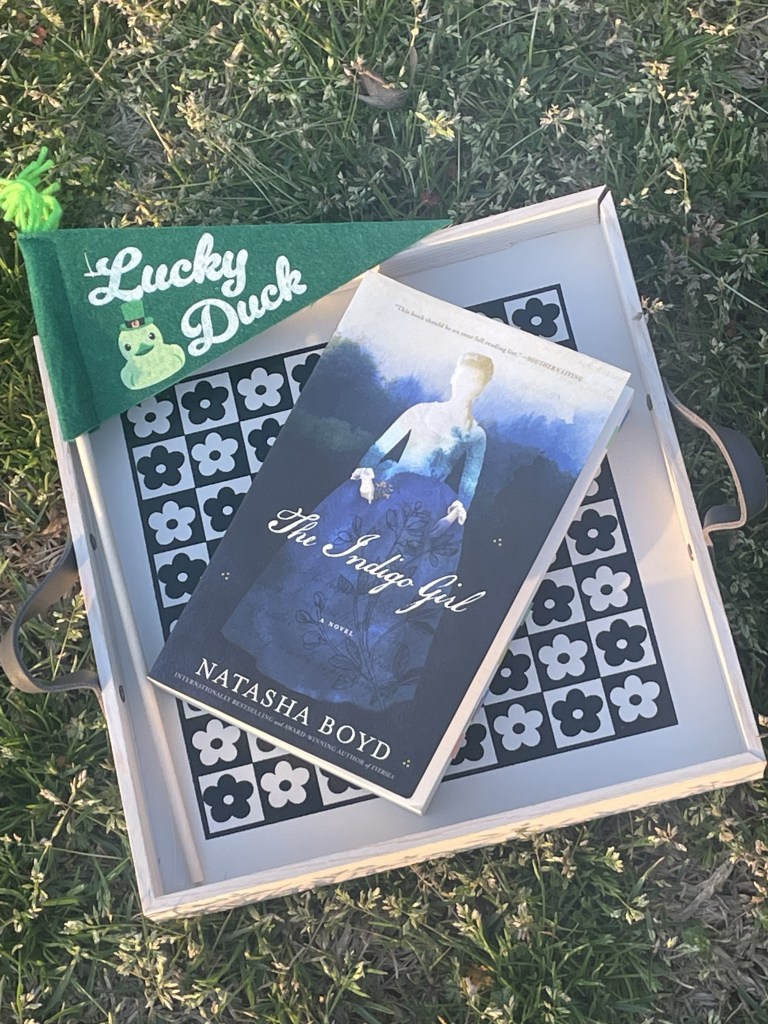
Based on historical documents, including Eliza’s letters, this is a historical fiction account of how a teenage girl produced indigo dye, which became one of the largest exports out of South Carolina, an export that laid the foundation for the incredible wealth of several Southern families who still live on today. Although largely overlooked by historians, the accomplishments of Eliza Lucas influenced the course of US history. When she passed away in 1793, President George Washington served as a pallbearer at her funeral.

The characters, heroes and villains alike, were all one-dimensional; flat. For the first seventy-five percent of the book, I had no issue with Eliza, but by the last quarter, I did not like her. She’s another example of a Mary Sue and whines like no other when things don’t go her way. Flat characters.

There are real historical letters immersed throughout the book, and the author had the dialogue and overall personality of Eliza spot on, transitioning from historical records to a fictional novel.

The atmosphere came right off the page. The author did a great job of depicting the area of coastal South Carolina and making it easy for the reader to picture the locales of the scenes.

The writing itself was fine, but bits and pieces of the dialogue did get repeated quite a bit, even within a page of each other. Also, I wonder how many times the author used the word ‘blue’ or some variation in the book. We get it, the book is about indigo!! This book does read young, and I think it would be great for young adults to read.

As an idea, the plot sounds pretty good. On the page, it just wasn’t executed properly. I was not gripped or intrigued by what would happen next, and that ultimately led me to skim-read the last quarters of the book. This story sounds unbelievable, but it’s a real story. However, some of the plot points were unnecessary and would have caused an uproar if genders had been reversed. However, as historical fiction, I do believe this was a well-researched story.

The characters, heroes and villains alike, were all one-dimensional; flat. The author did a great job of depicting the area of coastal South Carolina and making it easy for the reader to picture the locales of the scenes. The writing itself was fine, but bits and pieces of the dialogue did get repeated quite a bit, even within a page of each other. However, as historical fiction, I do believe this was a well-researched story. Overall, this book didn’t do a lot for me, and I really wouldn’t recommend it

3 out of 5 stars.

‘The Lady of the Rivers’ Review

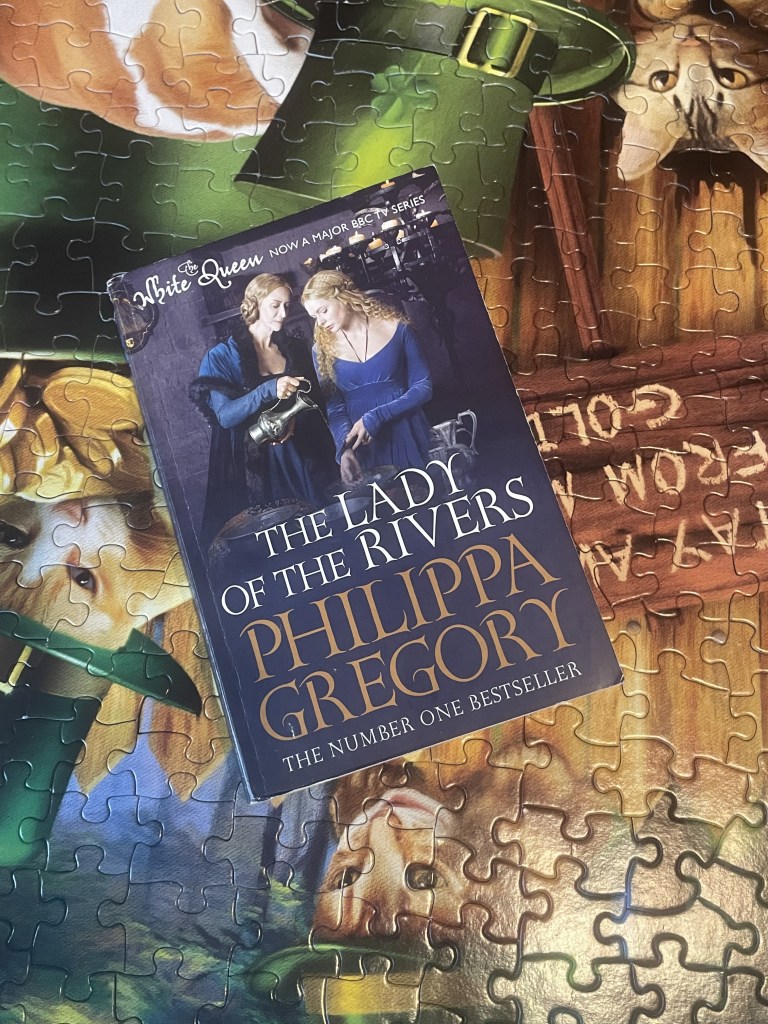
 “Philippa Gregory brings to life the story of Jacquetta, Duchess of Bedford, a woman of passion and of legend who navigated a treacherous path through the battle lines in the War of the Roses to bring her family unimaginable power.”

The character development was my favorite aspect of this story. We witness Jacquetta’s evolution from a young and innocent girl in a noble family to the wife of a much older man who objectifies her due to her supposed ancestor – a girl who only seeks love but cannot find it. Eventually, she becomes a lover and a woman in her own right, playing a prominent role in English politics. The development of her character is fantastic. Additionally, I thoroughly enjoyed the dynamics among all the nobility throughout the book. Gregory did a great job showcasing each character.

The atmosphere was fairytale-esque and witchy, another part of the novel that I highly enjoyed. While this is historical fiction, it almost felt like a fantasy novel. Many people may not like the book for these elements, finding them too outlandish. However, later in life, Jacquetta was indeed accused of bewitching Edward IV. I believe there must have been some basis for that, even if it was innocent, like the magic depicted in this novel. The story was atmospheric in the best way!

The writing is where I struggled. The words themselves were fine; I had no complaints with that part. My issue comes with the pacing and repetitive nature of the writing. The first two-thirds of the book were medium-paced, and I had no major issues. However, the last third of the book was slow, and I wanted the story to end already. Many plot points were repeated. Yes, these events are historical, but I wish that some had been glossed over. The way the story was told was fine, but it became lengthy and repetitive.

The plot was great. The Lady of the Rivers is a woman who has yet to have an actual historical biography written about her. This account is fiction, but I still enjoyed learning about her. She was around many influential people of her time and was a major player herself. The story showed what it was like to be a woman in Medieval Europe and the trials that came with it.

The character work was my favorite part of this story. The story was atmospheric in the best way! However, I struggled with the writing. The story effectively depicted the challenges faced by women in Medieval Europe. Overall, it was a great book, but it didn’t become a new favorite.

4 out of 5 stars.

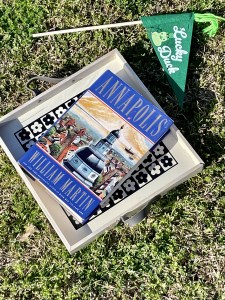
‘Annapolis’ Book Review

Annapolis by William Martin is a good fit for those who are interested in historical fiction that explores the proud traditions and romanticized ideals of the United States Navy, with a focus on the Stafford and Parrish families’ contributions to the nation’s military history.

The characters were placed for the sake of having characters and showcasing historical events. That isn’t to say that I didn’t like them, but they were not that well-developed, and once we hit the American Civil War, I had a hard time keeping up with who was who. There is also a lot of white saviorism in this book, and I know many people don’t like to read that, so I did want to make note of it in my review.

As you can tell by the title, the majority of the story takes place in Annapolis and the surrounding shores of the Chesapeake. The writing of the setting was spot-on, based on my own experiences in the area. It was so vivid and touched on all the senses.

The writing was fine. I liked how we had the two timelines and that the ‘historical’ settings were a part of a book that one of the characters was writing. However, it was episodic, and I think that is why I had a hard time connecting with the characters. There were a lot of loose ends between time periods that had me questioning. It was an interesting premise and take on a typical historical fiction novel.

The plot is the part that I am most excited to write about. As stated with the characters, I think the author really wanted to show the history of the navy as well as this country. The story was episodic, going from one war to the next. This book was very informative, and I learned a lot about some more forgotten bits of American history like fighting with Barbary pirates, the founding of the Navy, the War of 1812, and the Spanish-American War. However, WWI and Korea still remain forgotten. I learned a ton though, and that is my goal from reading.

The characters seemed to be placed primarily to serve as vehicles for showcasing historical events, but the vivid atmosphere evoked by the writing truly engaged the senses. The premise offered an intriguing take on the typical historical fiction novel. Despite some flaws, I found the book informative and fulfilling my goal of learning from reading. Overall, I would recommend it as a good read.

3.25 out of 5 stars.

‘Kindred’ Reader’s Guide Answers

  1. Both Kevin and Dana know that they can’t change history: “We’re in the middle of history. We surely can’t change it.” (page100); and “It’s over . . . There’s nothing you can do to change any of it now.” (page 264). What, then, are the purposes of Dana’ s travels back to the antebellum South? Why must you, the reader, experience this journey with Dana? – I think this book was probably really eye-opening at the time (1979) in showing the brutality of slavery, and how naive the modern population is, and that we shouldn’t forget our history and where our nation came from.
  2. How would the story have been different with a third person narrator? – I do not think the story would have been different with a third-person narrator. Personally, I prefer third person, but I believe the same points would still have been conveyed.
  3. Many of the characters within Kindred resist classification. In what ways does Dana explode the slave stereotypes? In what ways does she transcend them? – Dana transcends these roles by teaching and educating the other slaves. I believe it’s the magic of her ability to time travel, while the others cannot, that ultimately leaves a sense of wonder and raises questions about her.
  4. Despite Dana’s conscious effort to refuse the ‘mammy’ role in the Weylin household, she finds herself caught within it: “I felt like Sarah, cautioning.” (page 156), and others see her as the mammy: “You sound just like Sarah” (page 159). How, if at all, does Dana reconcile this behavior? How would you reconcile it? – I do not think Dana reconciles her conscious efforts with her behavior. I never really noticed this behavior to begin with. I don’t think I would reconcile them. I would just continue to live my life not caring what others thought.
  5. I do think that in the 21st century, we still have conditioned responses to slavery because of what people have been taught in school for so long. Many people don’t really care for history; they just acknowledge that ‘yes, this is bad,’ but they don’t truly realize the brutality of it.
  6. How do you think Butler confronts us with issues of difference in Kindred? How does she challenge us to consider boundaries of black/white, master/slave, husband/wife, past/present? What other differences does she convolute? Do you think such dichotomies are flexible? Artificial? Useful? – Butler challenges us to consider the boundaries between the people in the story by showing the complex relationships between all of the characters. As for other differences, I think it really shows the differences in time periods and how far we have come as a country, but also how there are still a lot of the same stigmas.
  7. Compare Tom Weylin and Rufus Weylin. Is Rufus an improvement or simply an alteration of his father? Where, if any, is there evidence of Dana’s influence on the young Rufus in his adult character? – I don’t think there really can be an improvement between Rufus and his father. Both were awful, and both did terrible things. I do think you can see hints of Dana’s influence on Rufus, mainly in regards to his children, but I won’t go into too much detail, as I don’t want to spoil the story.
  8. Of the slaves’ attitude toward Rufus, Dana observes “Strangely, they seemed to like him, hold him in contempt, and fear him at the same time.” (page 229) How is it they can feel these contradictory emotions? How would you feel toward Rufus if you were in their situation? – I couldn’t feel these contradictory emotions. I don’t think any of the slave characters seemed to like Rufus. I think they all thought he was a bit of a pest and annoying, and I would feel just like them. I would hate him too if I were in their situation.
  9. Compare Dana’s ‘professional’ life (i.e. her work as temporary help) in the present with her life as a slave. – Dana’s professional life in the present, with her riding, allows her to do something she wants to do. She gets to choose her job, so obviously it is way better than her life as a slave.
  10. When Dana and Kevin return from the past together, she thinks to herself: “I felt as though I were losing my place here in my own time. Rufus’s time was a sharper, stronger reality.” (page 191) Why would the twentieth century seem less vivid to Dana than the past? – I think the 20th century will seem less vivid to Dana than the 19th century because it was so brutal in the past, and people were just trying to survive. In the 20th century, they had the pleasure of doing what they wanted. They had freedom.
  11. Dana loses her left arm as she emerges—for the last time in the novel—from the past. Why is this significant? – From what the author has said, this is significant because everybody came away from slavery broken. Even today you can still see the impact it had on society . In how it divided people.
  12. Kevin is stranded in the past five years, while Dana is there for almost one. Is there a reason why Butler felt Kevin needed to stay in the past so much longer? How have their experiences affected their relationship to each other and to the world around them? – I saw Butler felt the need to have Kevin stay in the past so much longer than Dana, so he could truly understand the experience that she was going through because for a white man it was easier tremendously easier than to be a black woman in the 19th century, I think it definitely affected their relationship to each other, because of how different the mentality and morals were of the past.
  13. A common trend in the time-travels of science fiction assumes that one should not tamper with the past, lest s/he disrupt the present. Butler’s characters obviously ignore this theory and continue to invade each other’s lives. How does this influence the movement of the narrative? How does this convolute the idea of ’cause and effect’? – This influences the movement of the narrative by characters, not having to be scared or constantly having to have the same train of thought to me. It did not convolute the idea of cause-and-effect at all.
  14. Dana finds herself caught in the middle of the relationship between Rufus and Alice? Why does Rufus use Dana to get to Alice? Does Alice use Dana? – Rufus uses Dana to get to Alice because he sees them as the same woman he doesn’t see them as their own person so he thinks that Dana thinks like Alice does I would say Alice does use Dana as well because she knows that Dana have some kind of holdover Rufus, because of her abilities to travel through time.
  15. The needs and well-being of other residents of the plantation create a web of obligation that is difficult to navigate. Choose a specific incident; and determine who holds power over whom and assess how it affects that situation. – I think Dana holds a lot of obligation because she ultimately knows what will happen in history to all of these people maybe not individually but as a whole.
  16. Dana states: “It was that destructive single-minded love of his. He loved me. Not the way he loved Alice, thank God. He didn’t seem to want to sleep with me. But he wanted me around—someone to talk to, someone who would listen to him and care about what he said, care about it.” (page 180) How does the relationship between Dana and Rufus develop? How does it change? What are the different levels of love portrayed in Kindred?The relationship between Dana and Rufus develops of her, taking care of him after all his near death experiences, and that they hold each others lives in their hands in a sense, but like any relationship, you can grow tired of the other person just from constant neglect of the relationship and I think you can really see that here all different levels of lover portrayed in Kindred, romantic family. There are so many complex relationships in the story.
  17. Discuss the ways in which the title encapsulates the relationships within the novel. Is it ironic? Literal? Metaphorical? What emphasis do we place on our own kinship? How does it compare with that of the novel? – I think the title is ironic, literal and metaphorical. You can take it in any way you want; literature is art and it’s meant to be interpreted by the reader. I’m not sure how it compares with that of the novel; it’s something that I would definitely have to think about.
  18. Do you believe that Dana and Kevin’s story actually happened to them, or that they simply got caught up in the nostalgia of moving old papers and books? – I do believe that Dana and Kevin story actually happen because it is us too far out to get caught up in nostalgia, examining old papers and books.
     
  19. Butler opens the novel with the conclusion of Dana’s time travels. The final pages of the book, however, make up an epilogue demonstrating a, once again, linearly progressive movement of time. How does the epilogue serve to disrupt the rhythm of the narrative? – I do not think the epilogue serves to disrupt the rhythm of the narrative. I thought it fit in with the story perfectly as the characters were getting closure on the events that they went through.
  20. After returning from his years in the nineteenth-century, Kevin had attained “a slight accent” (page 190). Is this `slight’ alteration symbolic of greater changes to come? How do you imagine Kevin and Dana’s relationship will progress following their re-emergence into life in 1976? – I do think this alteration is symbolic of greater chances change is to come I think that being in the past for so long definitely did change Kevin’s mentality how I imagined Kevin and Dana‘s relationship of progress following reentry to life in 1976 I can see them staying as a couple because they went through this incredible traumatic journey together, but also how the mentalities were impacted as I keep saying I don’t know if it would be good for them to stay together or not.

‘Owen’ Book Review

‘Owen’ is the story of a man who went from a Welsh solider in the English army, to a servant, and then ended up marrying the dowager queen of England. His descendants would go on to rule multiple countries around Europe. The founder of a great dynasty that would change England and therefore the world.

Owen Tudor is one of the people in the Wars of the Roses, that I have never seen portrayed in film or writing. That was until I read this book. I think it is quite strange that many have not ventured into writing about this man as in a sense he founded the Tudor Dynasty. The character work here is very one dimensional but I can see why since there is not a lot to base Owen on. I did like the portrayal of Queen Catherine and the dialogue that came along with that.

I have talked far and wide for my love of the Middle Ages and more specifically the Wars of the Roses time period. The author did a great deal of research on the time period and the people in it.

The writing is where I think this fell flat for me but it also could have been the plot but we will get to that. It was very mechanical and simple. Which does make for an easy read but I got bored with it. One dimensional is a word that I would use to overall describe my time reading ‘Owen’.

As stated before, it is obvious that the writer did his research for the first installment of the Tudor trilogy. That is great but it also held him back a lot. If you know the life of Owen Tudor that is exactly what you are going to get with very few moments going in depth or veering off course. It got dull and repetitive as the story went on.

The character work here is very one dimensional but I can see why since there is not a lot to base Owen on.The author did a great deal of research on the time period and the people in it. The writing was very mechanical and simple. The plot got dull and repetitive as the story went on. I did not hate this book or love it, I left it with no strong feelings therefore it will a receive a 2.5 star.

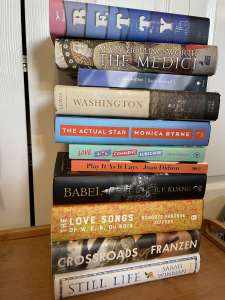
Five Star Predictions for 2023

Here are the books that I plan to read this year, 2023, that I believe will be five stars. The best of the best. I will be leaving the description of each book below but I would like to say that these are copied from Goodreads and not personally written by me.

Betty –

So begins the story of Betty Carpenter. Born in a bathtub in 1954 to a Cherokee father and white mother, Betty is the sixth of eight siblings. The world they inhabit is one of poverty and violence–both from outside the family, and also, devastatingly, from within. The lush landscape, rich with birdsong, wild fruit, and blazing stars, becomes a kind of refuge for Betty, but when her family’s darkest secrets are brought to light, she has no choice but to reckon with the brutal history hiding in the hills, as well as the heart-wrenching cruelties and incredible characters she encounters in her rural town of Breathed, Ohio.

Inspired by the life of her own mother, Tiffany McDaniel sets out to free the past by telling this heartbreaking yet magical story–a remarkable novel that establishes her as one of the freshest and most important voices in American fiction.

Love, Pamela – 

PAMELA ANDERSON’s blond bombshell image was ubiquitous in the 1990s. Discovered in the stands during a Canadian football game, she was quickly launched into superstardom, becoming Playboy‘s favorite cover girl and an emblem of Hollywood glamour and sex appeal. Yet the Pamela Anderson we think we know was created through happenstance rather than careful cultivation. Love, Pamela brings forth her true story: that of a small-town girl getting tangled up in her own dream.

Pamela forged ahead with grace, finding sanctuary in her love of art and literature, and emerged a devoted mother and activist. Now, having returned to the island of her childhood, after a memorable run starring as Roxie in Chicago on Broadway, Pamela is telling her story, a story of an irrepressible free spirit coming home and discovering herself anew at every turn. With vivid prose interspersed with bursts of original poetry, Love, Pamela is a pensive, layered, and unforgettable memoir. 

The Medici – 

Wealthy bankers, wise politicians, patrons of the arts, glittering dukes… so runs the traditional telling of the story of the Medici, the family that ruled Florence for two hundred years and inspired the birth of the Italian Renaissance.

In this definitive account of their rise and fall, Mary Hollingsworth argues that the idea that the Medici were wise rulers and enlightened fathers of the Renaissance is a fiction. In truth, she says, the Medici were as devious and immoral as the Borgias – tyrants loathed in the city they illegally made their own and which they beggared in their lust for power.

Ghostwritten – 

A gallery attendant at the Hermitage. A young jazz buff in Tokyo. A crooked British lawyer in Hong Kong. A disc jockey in Manhattan. A physicist in Ireland. An elderly woman running a tea shack in rural China. A cult-controlled terrorist in Okinawa. A musician in London. A transmigrating spirit in Mongolia. What is the common thread of coincidence or destiny that connects the lives of these nine souls in nine far-flung countries, stretching across the globe from east to west? What pattern do their linked fates form through time and space?

A writer of pyrotechnic virtuosity and profound compassion, a mind to which nothing human is alien, David Mitchell spins genres, cultures, and ideas like gossamer threads around and through these nine linked stories. Many forces bind these lives, but at root all involve the same universal longing for connection and transcendence, an axis of commonality that leads in two directions—to creation and to destruction. In the end, as lives converge with a fearful symmetry, Ghostwritten comes full circle, to a point at which a familiar idea—that whether the planet is vast or small is merely a matter of perspective—strikes home with the force of a new revelation. It marks the debut novel of a writer with astonishing gifts.

Washington – 

On January 24, 1791, President George Washington chose the site for the young nation’s capital: ten miles square, it stretched from the highest point of navigation on the Potomac River, and encompassed the ports of Georgetown and Alexandria. From the moment the federal government moved to the District of Columbia in December 1800, Washington has been central to American identity and life. Shaped by politics and intrigue, poverty and largess, contradictions and compromises, Washington has been, from its beginnings, the stage on which our national dramas have played out.

“It is our national center,” Frederick Douglass once said of Washington, DC; “it belongs to us, and whether it is mean or majestic, whether arrayed in glory or covered in shame, we cannot but share its character and its destiny.” Interweaving the story of the city’s physical transformation with a nuanced account of its political, economic, and social evolution, Lewis tells the powerful history of Washington, DC ” the site of our nation’s highest ideals and some of our deepest failures.

The Actual Star – 

The Actual Star takes readers on a journey over thousands of years and six continents —collapsing three separate timelines into one cave in the Belizean jungle.

In each era, age-old questions about existence and belonging and identity converge deep underground. Because only in complete darkness can one truly see the stars. 

Love, Comment, Subscribe – 

Back in high school, Lily Wang wanted to be popular, but she considered herself lucky to be part of a tight group of oddballs and honors students called the Nerd Herd. Now, at twenty-eight, she feels like she’s finally on the cusp of succeeding as a beauty influencer—if she can hit five million subscribers, brands will take notice and she could get her own makeup line.

Fellow Nerd Herd alum Tobin Bui has had a lot of success as a YouTube gamer. But the road to online stardom has been rocky. First, he disappointed his parents by dropping out of college, and now, after years of pranks, skits, and playthroughs, he’s struggling to come up with new content to satisfy his ever-growing fan base. His agents say he needs cross-audience appeal, a new twist.

Play it as it Lays – 

A ruthless dissection of American life in the late 1960s, Play It as It Lays captures the mood of an entire generation, the ennui of contemporary society reflected in spare prose that blisters and haunts the reader. Set in a place beyond good and evil – literally in Hollywood, Las Vegas, and the barren wastes of the Mojave Desert, but figuratively in the landscape of an arid soul – it remains more than three decades after its original publication a profoundly disturbing novel, riveting in its exploration of a woman and a society in crisis and stunning in the still-startling intensity of its prose.

Babel – 

1828. Robin Swift, orphaned by cholera in Canton, is brought to London by the mysterious Professor Lovell. There, he trains for years in Latin, Ancient Greek, and Chinese, all in preparation for the day he’ll enroll in Oxford University’s prestigious Royal Institute of Translation—also known as Babel.

For Robin, Oxford is a utopia dedicated to the pursuit of knowledge. But knowledge obeys power, and as a Chinese boy raised in Britain, Robin realizes serving Babel means betraying his motherland. As his studies progress, Robin finds himself caught between Babel and the shadowy Hermes Society, an organization dedicated to stopping imperial expansion. When Britain pursues an unjust war with China over silver and opium, Robin must decide…

The Love Songs of W.E.B Dubois –

The great scholar, W. E. B. Du Bois once wrote about the Problem of Race in America, and what he called “Double Consciousness,” a sensitivity that every African American possesses in order to survive. Since childhood, Ailey Pearl Garfield has understood Du Bois’s words all too well. Bearing the names of two formidable Black Americans—the revered choreographer Alvin Ailey and her great grandmother Pearl, the descendant of enslaved Georgians and tenant farmers—Ailey carries Du Bois’s Problem on her shoulders.

To come to terms with her own identity, Ailey embarks on a journey through her family’s past, uncovering the shocking tales of generations of ancestors—Indigenous, Black, and white—in the deep South. In doing so Ailey must learn to embrace her full heritage, a legacy of oppression and resistance, bondage and independence, cruelty and resilience that is the story—and the song—of America itself.

Crossroads –

It’s December 23, 1971, and heavy weather is forecast for Chicago. Russ Hildebrandt, the associate pastor of a liberal suburban church, is on the brink of breaking free of a marriage he finds joyless–unless his wife, Marion, who has her own secret life, beats him to it. Their eldest child, Clem, is coming home from college on fire with moral absolutism, having taken an action that will shatter his father. Clem’s sister, Becky, long the social queen of her high-school class, has sharply veered into the counterculture, while their brilliant younger brother Perry, who’s been selling drugs to seventh graders, has resolved to be a better person. Each of the Hildebrandts seeks a freedom that each of the others threatens to complicate.

A tour de force of interwoven perspectives and sustained suspense, its action largely unfolding on a single winter day, Crossroads is the story of a Midwestern family at a pivotal moment of moral crisis. Jonathan Franzen’s gift for melding the small picture and the big picture has never been more dazzlingly evident. 

Still Life – 

Tuscany, 1944: As Allied troops advance and bombs fall around deserted villages, a young English soldier, Ulysses Temper, finds himself in the wine cellar of a deserted villa. There, he has a chance encounter with Evelyn Skinner, a middle-aged art historian who has come to Italy to salvage paintings from the ruins and recall long-forgotten memories of her own youth. In each other, Ulysses and Evelyn find a kindred spirit amongst the rubble of war-torn Italy, and set off on a course of events that will shape Ulysses’s life for the next four decades.

With beautiful prose, extraordinary tenderness, and bursts of humor and light, Still Life is a sweeping portrait of unforgettable individuals who come together to make a family, and a richly drawn celebration of beauty and love in all its forms.