- Both Kevin and Dana know that they can’t change history: “We’re in the middle of history. We surely can’t change it.” (page100); and “It’s over . . . There’s nothing you can do to change any of it now.” (page 264). What, then, are the purposes of Dana’ s travels back to the antebellum South? Why must you, the reader, experience this journey with Dana? – I think this book was probably really eye-opening at the time (1979) in showing the brutality of slavery, and how naive the modern population is, and that we shouldn’t forget our history and where our nation came from.
- How would the story have been different with a third person narrator? – I do not think the story would have been different with a third-person narrator. Personally, I prefer third person, but I believe the same points would still have been conveyed.
- Many of the characters within Kindred resist classification. In what ways does Dana explode the slave stereotypes? In what ways does she transcend them? – Dana transcends these roles by teaching and educating the other slaves. I believe it’s the magic of her ability to time travel, while the others cannot, that ultimately leaves a sense of wonder and raises questions about her.
- Despite Dana’s conscious effort to refuse the ‘mammy’ role in the Weylin household, she finds herself caught within it: “I felt like Sarah, cautioning.” (page 156), and others see her as the mammy: “You sound just like Sarah” (page 159). How, if at all, does Dana reconcile this behavior? How would you reconcile it? – I do not think Dana reconciles her conscious efforts with her behavior. I never really noticed this behavior to begin with. I don’t think I would reconcile them. I would just continue to live my life not caring what others thought.
- I do think that in the 21st century, we still have conditioned responses to slavery because of what people have been taught in school for so long. Many people don’t really care for history; they just acknowledge that ‘yes, this is bad,’ but they don’t truly realize the brutality of it.
- How do you think Butler confronts us with issues of difference in Kindred? How does she challenge us to consider boundaries of black/white, master/slave, husband/wife, past/present? What other differences does she convolute? Do you think such dichotomies are flexible? Artificial? Useful? – Butler challenges us to consider the boundaries between the people in the story by showing the complex relationships between all of the characters. As for other differences, I think it really shows the differences in time periods and how far we have come as a country, but also how there are still a lot of the same stigmas.
- Compare Tom Weylin and Rufus Weylin. Is Rufus an improvement or simply an alteration of his father? Where, if any, is there evidence of Dana’s influence on the young Rufus in his adult character? – I don’t think there really can be an improvement between Rufus and his father. Both were awful, and both did terrible things. I do think you can see hints of Dana’s influence on Rufus, mainly in regards to his children, but I won’t go into too much detail, as I don’t want to spoil the story.
- Of the slaves’ attitude toward Rufus, Dana observes “Strangely, they seemed to like him, hold him in contempt, and fear him at the same time.” (page 229) How is it they can feel these contradictory emotions? How would you feel toward Rufus if you were in their situation? – I couldn’t feel these contradictory emotions. I don’t think any of the slave characters seemed to like Rufus. I think they all thought he was a bit of a pest and annoying, and I would feel just like them. I would hate him too if I were in their situation.
- Compare Dana’s ‘professional’ life (i.e. her work as temporary help) in the present with her life as a slave. – Dana’s professional life in the present, with her riding, allows her to do something she wants to do. She gets to choose her job, so obviously it is way better than her life as a slave.
- When Dana and Kevin return from the past together, she thinks to herself: “I felt as though I were losing my place here in my own time. Rufus’s time was a sharper, stronger reality.” (page 191) Why would the twentieth century seem less vivid to Dana than the past? – I think the 20th century will seem less vivid to Dana than the 19th century because it was so brutal in the past, and people were just trying to survive. In the 20th century, they had the pleasure of doing what they wanted. They had freedom.
- Dana loses her left arm as she emerges—for the last time in the novel—from the past. Why is this significant? – From what the author has said, this is significant because everybody came away from slavery broken. Even today you can still see the impact it had on society . In how it divided people.
- Kevin is stranded in the past five years, while Dana is there for almost one. Is there a reason why Butler felt Kevin needed to stay in the past so much longer? How have their experiences affected their relationship to each other and to the world around them? – I saw Butler felt the need to have Kevin stay in the past so much longer than Dana, so he could truly understand the experience that she was going through because for a white man it was easier tremendously easier than to be a black woman in the 19th century, I think it definitely affected their relationship to each other, because of how different the mentality and morals were of the past.
- A common trend in the time-travels of science fiction assumes that one should not tamper with the past, lest s/he disrupt the present. Butler’s characters obviously ignore this theory and continue to invade each other’s lives. How does this influence the movement of the narrative? How does this convolute the idea of ’cause and effect’? – This influences the movement of the narrative by characters, not having to be scared or constantly having to have the same train of thought to me. It did not convolute the idea of cause-and-effect at all.
- Dana finds herself caught in the middle of the relationship between Rufus and Alice? Why does Rufus use Dana to get to Alice? Does Alice use Dana? – Rufus uses Dana to get to Alice because he sees them as the same woman he doesn’t see them as their own person so he thinks that Dana thinks like Alice does I would say Alice does use Dana as well because she knows that Dana have some kind of holdover Rufus, because of her abilities to travel through time.
- The needs and well-being of other residents of the plantation create a web of obligation that is difficult to navigate. Choose a specific incident; and determine who holds power over whom and assess how it affects that situation. – I think Dana holds a lot of obligation because she ultimately knows what will happen in history to all of these people maybe not individually but as a whole.
- Dana states: “It was that destructive single-minded love of his. He loved me. Not the way he loved Alice, thank God. He didn’t seem to want to sleep with me. But he wanted me around—someone to talk to, someone who would listen to him and care about what he said, care about it.” (page 180) How does the relationship between Dana and Rufus develop? How does it change? What are the different levels of love portrayed in Kindred? – The relationship between Dana and Rufus develops of her, taking care of him after all his near death experiences, and that they hold each others lives in their hands in a sense, but like any relationship, you can grow tired of the other person just from constant neglect of the relationship and I think you can really see that here all different levels of lover portrayed in Kindred, romantic family. There are so many complex relationships in the story.
- Discuss the ways in which the title encapsulates the relationships within the novel. Is it ironic? Literal? Metaphorical? What emphasis do we place on our own kinship? How does it compare with that of the novel? – I think the title is ironic, literal and metaphorical. You can take it in any way you want; literature is art and it’s meant to be interpreted by the reader. I’m not sure how it compares with that of the novel; it’s something that I would definitely have to think about.
- Do you believe that Dana and Kevin’s story actually happened to them, or that they simply got caught up in the nostalgia of moving old papers and books? – I do believe that Dana and Kevin story actually happen because it is us too far out to get caught up in nostalgia, examining old papers and books.
- Butler opens the novel with the conclusion of Dana’s time travels. The final pages of the book, however, make up an epilogue demonstrating a, once again, linearly progressive movement of time. How does the epilogue serve to disrupt the rhythm of the narrative? – I do not think the epilogue serves to disrupt the rhythm of the narrative. I thought it fit in with the story perfectly as the characters were getting closure on the events that they went through.
- After returning from his years in the nineteenth-century, Kevin had attained “a slight accent” (page 190). Is this `slight’ alteration symbolic of greater changes to come? How do you imagine Kevin and Dana’s relationship will progress following their re-emergence into life in 1976? – I do think this alteration is symbolic of greater chances change is to come I think that being in the past for so long definitely did change Kevin’s mentality how I imagined Kevin and Dana‘s relationship of progress following reentry to life in 1976 I can see them staying as a couple because they went through this incredible traumatic journey together, but also how the mentalities were impacted as I keep saying I don’t know if it would be good for them to stay together or not.
Tag: New
January Book Haul
In 2024, I am allowing myself to buy as many books as I read the month before. In January, that number is eleven. However, you will see more than eleven books included. Why is that? I did receive one gift, aka I did not buy that book, and all my Book of the Month subscription books will only count as one. Let’s get into the haul!
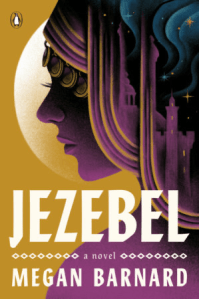
Jezebel by Megan Barnard
When Jezebel learns she can’t be a king like her father simply because she’s a girl, she vows never to become someone’s decorative wife, nameless and lost to history. At fifteen she’s married off, despite her protests, to Prince Ahab of Israel. There, she does what she must to gain power and remake the dry and distant kingdom in the image of her beloved, prosperous seaside homeland of Tyre, beginning by building temples to the gods she grew up worshipping. As her initiatives usher in an era of prosperity for Israel, her new subjects love her, and her name rings through the land.
I picked up ‘Jezebel’ at Barnes and Noble. It caught my attention after reading ‘The Red Tent,’ a book I loved in 2023. I wanted to add more biblical retellings to my TBR list!
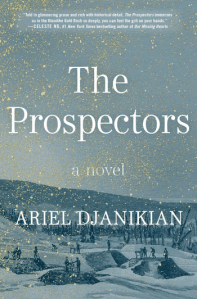
The Prospectors by Ariel Djanikian
Bringing the Klondike and turn-of-the-century California to vivid life, Ariel Djanikian weaves an ambitious narrative of claiming the American Dream and its rippling effects across generations. Sweeping and awe-inspiring, The Prospectors is an unforgettable story of family loyalties that interrogates the often-overlooked hostilities and inequities born during the Gold Rush era.
I’ll be honest; the cover drew me in when I saw the sun reflecting on the gold at Barnes and Noble. Upon opening the book, I discovered it’s a family saga with two timelines, and of course, I was sold. Funny thing is, I had no idea this was on my ‘want to read’ list on Goodreads! I guess I know my taste well.
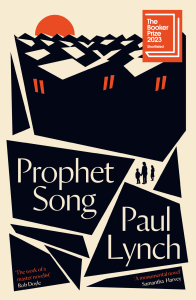
Prophet Song by Paul Lynch
Ireland is falling apart. The country is in the grip of a government turning towards tyranny and when her husband disappears, Eilish finds herself caught within the nightmare logic of a society that is quickly unravelling.
This is the book I set out to buy on my Barnes and Noble trip. I aim to read as many Booker Prize-nominated books as possible. The bonus here is that it’s a dystopian novel with an Irish setting!

Flight of Icarus by Caitlin Schneiderhan
Recording costs money. Money Eddie doesn’t have. But he’s willing to do whatever it takes, even if that means relying on his dad. Al Munson has just stumbled back into Eddie’s life with another dubious scheme up his sleeve, and yet Eddie knows this is his only option to make enough dough in enough time. It’s a risk, but if it pays off he will finally have a one-way ticket out of Hawkins.
This one caught me by surprise. I had no idea this book existed until it popped up on Amazon one day. Having read all the other Stranger Things books and generally enjoyed them, I’ll be continuing the series with this one. My expectations aren’t high, as it seems like this book may be more of a fan service for Joseph Quinn fans. However, I hope I’m wrong and end up enjoying it!

Elvis and Me by Priscilla Beaulieu Presley
Decades after his death, millions of fans continue to worship Elvis the legend. But very few knew him as Elvis the man. Here in her own words, Priscilla Presley tells the story of their love, revealing the details of their first meeting, their marriage, their affairs, their divorce, and the unbreakable bond that has remained long after his tragic death.
In late December, I watched the movie ‘Priscilla,’ which is based on this book. It was an alright film, but I believe the book will offer much more insight into Priscilla’s life!
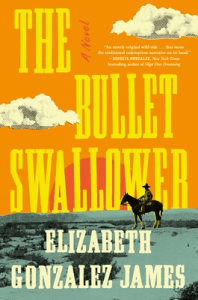
The Bullet Swallower by Elizabeth Gonzalez James
A dazzling magical realism western in the vein of Cormac McCarthy meets Gabriel García Márquez,The Bullet Swallower follows a Mexican bandido as he sets off for Texas to save his family, only to encounter a mysterious figure who has come, finally, to collect a cosmic debt generations in the making.
We’ve reached the Book of the Month books. This one was my January pick. I’m a fan of a good western and family saga. Plus, being compared to Gabriel García Márquez – need I say more?

Mercury by Amy Jo Burns
The Joseph brothers become Marley’s whole world before she can blink. Soon, she is young wife to one, The One Who Got Away to another, and adopted mother to them all. As their own mother fades away and their roofing business crumbles under the weight of their unwieldy father’s inflated ego, Marley steps in to shepherd these unruly men. Years later, an eerie discovery in the church attic causes old wounds to resurface and suddenly the family’s survival hangs in the balance. With Marley as their light, the Joseph brothers must decide whether they can save the family they’ve always known—or whether together they can build something stronger in its place.
I noticed that ‘Mercury’ is set in the 1990s. I love books from that time period; they always evoke a sense of nostalgia for me. Being a nostalgia chaser, I couldn’t say no to this ‘historical’ novel.
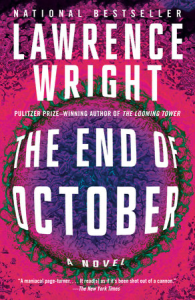
The End of October by Lawerence Wright
At an internment camp in Indonesia, forty-seven people are pronounced dead with acute hemorrhagic fever. When epidemiologist Henry Parsons travels there on behalf of the World Health Organization to investigate, what he finds will have staggering repercussions. Halfway across the globe, the deputy director of U.S. Homeland Security scrambles to mount a response to the rapidly spreading pandemic leapfrogging around the world, which she believes may be the result of an act of biowarfare. And a rogue experimenter in man-made diseases is preparing his own terrifying solution.
In January, I focused on reading science fiction so I did want to buy more of those as my stack has dwindled. One of my favorite sci-fi tropes is pandemic fiction. And then I lived that in real life… that only makes it more fun (?) to compare how a pandemic is on paper versus in person.
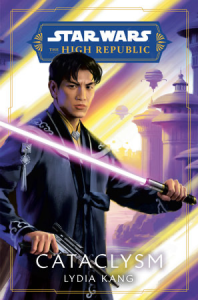
Cataclysm by Lydia Kang
After five years of conflict, the planets Eiram and E’ronoh are on the cusp of real peace. But when news breaks of a disaster at the treaty signing on Jedha, violence reignites on the beleaguered worlds. Together, the royal heirs of both planets—Phan-tu Zenn and Xiri A’lbaran—working alongside the Jedi, have uncovered evidence that the conflict is being orchestrated by outside forces, and all signs point to the mysterious Path of the Open Hand, whom the Jedi also suspect of causing the disaster on Jedha.
As mentioned earlier, I delved into a lot of sci-fi in January, and one of those books happened to be ‘Convergence,’ the prequel to this one. I’m determined to do a better job at getting through series instead of letting the plot fade and the book sit there for years. Here’s to doing better in 2024!

City of Dreams by Beverly Swerling
In what will be the greatest city in the New World, the fortunes of these two families are inextricably entwined by blood and fire in an unforgettable American saga of pride and ambition, love and hate, and the becoming of the dream that is New York City.
It’s pretty obvious that I love big chunky historical novels. This is the first book of a series, and I couldn’t be more thrilled to go down that rabbit hole. I found it at a used bookstore called Books and Moore in Calabash, North Carolina.
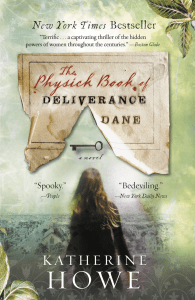
The Physical Book of Deliverance Dane by Katherine Howe
A spellbinding, beautifully written novel that moves between contemporary times and one of the most fascinating and disturbing periods in American history – the Salem witch trials.
It’s kind of crazy how I found this one. The night before my trip to Calabash, I was scrolling through Goodreads and came across this book with dual timelines and about witches. I added it to my ‘want to read’ list and had no idea I would find it the next day. It’s so rare to discover a book you just heard about at the used bookstore the next day!
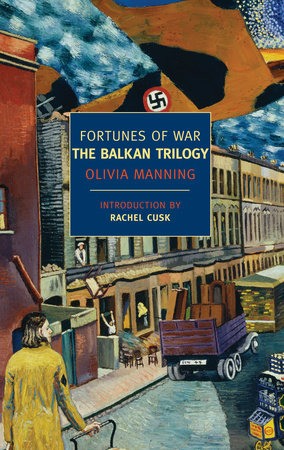
The Balkan Trilogy by Olivia Manning
The Balkan Trilogy is the story of a marriage and of a war, a vast, teeming, and complex masterpiece in which Olivia Manning brings the uncertainty and adventure of civilian existence under political and military siege to vibrant life. Manning’s focus is not the battlefield but the café and kitchen, the bedroom and street, the fabric of the everyday world that has been irrevocably changed by war, yet remains unchanged.
I discovered this trilogy through the YouTube channel Hard Cover Hearts. I’m intrigued to learn about a new place in a time that I have already learned so much about. I purchased this book at the best independent bookstore I have visited in South Carolina, and that is Book Ends in North Myrtle Beach.

Mister Hockey by Lia Riley
For fans of Icebreaker—sparks fly between a hockey player with a dirty mouth and an awkward bookworm in this spicy hockey romance.
A hockey book set in the NHL and not at the collegiate level? Oh my! Yeah, I had to grab it off the shelf at Target. It’s short, so it will be perfect for adding to my reading list of romance books for February, and it was on sale!

The Employee by Olga Ravn
Shortlisted for the International Booker Prize, The Employees reshuffles a sci-fi voyage into a riotously original existential nightmare. Aboard the interstellar Six Thousand Ship, the human and humanoid crew members complain about their daily tasks in a series of staff reports and memos. When the ship takes on a number of strange objects from the planet New Discovery, the crew becomes deeply attached to them, even as tensions boil toward mutiny, especially among the humanoids. In chilling, crackling, and exhilarating prose, The Employees probes into what makes us human, while delivering a hilariously stinging critique of life governed by the logic of productivity.
Lastly, we have the book that was gifted to me by Ben. Thank you! This is our only piece of translated fiction on the list, and it is coming to us from Denmark. I have seen several reviews for this book on YouTube and cannot wait to give it a try. I plan on reading it this week!
‘Wanderers’ Book Review
“”Wanderers” by Chuck Wendig is a gripping speculative fiction novel that follows the journey of a mysterious epidemic sweeping across America. People begin sleepwalking in vast numbers, becoming part of a silent, enigmatic march towards an unknown destination. As society grapples with fear and uncertainty, a group of individuals connected to the sleepwalkers embarks on a perilous quest to unravel the truth behind this phenomenon. The story delves deep into themes of humanity, survival, and the consequences of societal breakdown in the face of a catastrophic event.” – Summary from ChatGPT.
The characters were my biggest struggle in ‘Wanderers’. They are great in concept. We follow a girl whose sister is a sleepwalker, a CDC scientist, an evangelical preacher, and a few others who are not as directly impacted. Shana, the sister, drove me crazy. I do not believe that the author could write a female teenager well. She was so much like ‘I’m not like other girls’, so edgy and rebellious. You can make a character like that but also not make their chapters a major eye roll. I felt no strong emotional pull to these characters, but Benji, the scientist, and Matthew, the preacher, were my favorites to read from. I loved that we got to see the apocalypse from so many perspectives: religious, scientific, and then your normal everyday person.
I always love it when a science fiction novel takes place in our real world. This is very much an American-centric novel, but we do get bits and pieces of what is happening in other parts of the world. The reader goes on a great cross-country journey with these characters, and you can really feel the struggles of the atmosphere around them.
The writing is another aspect that I had a bit of a hard time with at the start of the story but grew more accustomed to as the novel went on. The dialogue wasn’t realistic; the way characters talked was just strange—people don’t really talk like that. This book was comedic at times, and I don’t know if those instances of dialogue, mainly Shana’s chapters, were supposed to be like that on purpose. Going along with that, the reader gets every little detail of the characters’ thought process, which I found to be unnecessary. This is a very heavy book, not just by subject matter, but the scientific discussions might go over the head of some. I found them to be interesting, so that did not hinder my experience, but this is a very heavily written book.
Here is a rare statement to come in a book review written by me: The plot was the highlight. This is one of the best science fiction plots that I have read in years. It is so logical and therefore scary by how real it feels. I do not have any clue how this book was published before the COVID pandemic because the author hit the nail on the head on how Americans react to a pandemic. There is a lot of commentary on politics and society. Yeah, if you are not a political person and read for escapism, maybe don’t pick this one up. There were so many twists and turns that I did not expect—some made me gasp, while others just made me sit back in almost despair. It is hard for me to sum up this plot by how epic it was.
The characters were my biggest struggle in ‘Wanderers’. I always love it when a science fiction novel takes place in our real world. The writing is another aspect that I had a bit of a hard time with at the start of the story but grew more accustomed to as the novel went on. Here is a rare statement to come in a book review written by me: The plot was the highlight. I loved this book even though at times, I did contemplate not finishing. I am glad that I stayed on and finished the journey with the characters. This was a great book, and I loved it, but it is not a new favorite.
4 out 5 stars.
The Best Books of 2023

The best books of 2023! Three of these, the TJR ones, were rereads, so I was iffy on including them, but here they are! It’s hard to believe that a short story collection was my first five-star read of the year! That was followed by a thriller and a romance, which is equally as shocking as I struggle with those genres at times. “The Love Songs of W.E.B. Du Bois” takes the cake as the best book of the year, followed closely by “Betty” and “Love, Pamela”. It was a great year with 125 books read in total!
Florida by Lauren Groff:
It takes a lot of talent for a writer to be able to make you connect with a character in a fifteen-page short story. Sometimes, I cannot find a connection with characters in a five-hundred-page tome. Lauren Groff has that talent. The reader is dropped right into Florida with this one. Groff hit the nail on the head by having her writing perfectly match up with the setting. Speaking of the writing, it was captivating and poetic. The main theme here is survival, not necessarily out in the wilderness, but sometimes just getting through a long day that never seems to end, just getting through day-to-day life. I loved this book. It’s my first five-star read of the year and my new favorite.
No Exit by Taylor Adams:
Wow! Me, giving a thriller a perfect five out of five rating? This is an incredibly rare event that I never thought would happen. The book completely exceeded my expectations, delivering a thrilling experience that kept me guessing until the very end. This is exactly how a thriller should be written, with unexpected twists and turns that leave readers on the edge of their seats. I’m truly amazed by this exceptional book.
Get a Life Chloe Brown by Talia Hibbert:
Chloe Brown emerges as one of the most relatable characters I’ve encountered in literature. The representation of chronic illness and the accompanying anxieties was handled impeccably. Towards the end, Red’s character began to grate on me due to the weight of his unresolved baggage; however, this didn’t significantly detract from my overall enjoyment of the story. The British setting, which I hadn’t anticipated, added a delightful dimension, complemented by a wonderful sense of humor throughout. While the writing style was average, this book fulfilled my ideal romance criteria, ranking among the finest I’ve read. It’s undeniably become a new favorite of mine, and I wholeheartedly recommend it!
Betty by Tiffany McDaniel:
Recently, I’ve discovered that many writers tend to overwhelm their narratives with numerous characters, leaving them as mere names on a page devoid of distinct traits. However, this book defies that trend brilliantly. It presents a family of eight vibrant characters, each with their own well-defined personality, ensuring the reader never confuses one with another. The emotional bond formed with these characters is palpable, particularly in the poignant portrayal of Betty and her father, Landon. The book encapsulates the essence of ‘Americana,’ a gritty and authentic depiction that resonates universally. The writing is exceptional, adorned with memorable quotes, especially those about the ever-changing yet perpetual seasons. The story, much like the mother’s quilt referenced throughout, is flawlessly woven together without plot holes, exhibiting impeccable logic. Themes of poverty, trauma, life’s stages, and most prominently, womanhood, are skillfully explored. ‘Betty’ embodies the idea of staying true to oneself amidst societal pressures. This book, touted for its emotional impact, lived up to its acclaim. I feel profoundly moved upon its completion, making it the first five-star prediction fulfilled in my 2023 reading project.
Love, Pamela by Pamela Anderson:
Authentic, intelligent, and deeply relatable. In the closing pages, Pamela reflects on a director’s observation about her vulnerability, a quality missing in today’s stars, and that sentiment encapsulates this book perfectly. It’s refreshingly open and distinctive, penned entirely by Pamela in various forms, seamlessly interweaving poetry and prose. Her ability to reclaim her narrative, shedding the constructs imposed by men and the media over the years, is empowering. The raw honesty shines through, making this book a standout for me, earning a spot among my newfound favorites.
Beach Music by Pat Conroy:
Conroy exhibits exceptional skill in character development, intricately weaving captivating family relationships in his narratives. In ‘Beach Music,’ South Carolina becomes the pulsating heart of the story. Conroy masterfully captures the essence of this setting and its atmosphere, crafting an unparalleled portrayal. While his depiction of Italy is remarkable, his depiction of South Carolina truly stands out. His writing is richly descriptive, possibly overwhelming for some readers, making it best suited for those more accustomed to immersive storytelling. The plot defies easy description, carrying an epic quality that is both striking and challenging to articulate. While Conroy employs recurring tropes, making binge-reading less advisable, his works remain a compelling choice for seasoned readers seeking depth and complexity in their literature.
Us Against You by Fredrik Backman:
I’m honestly astounded by this author’s ability to create a multitude of characters, each so distinct and wonderfully developed—a truly rare talent. This narrative brilliantly builds upon the community introduced in the previous book, crafting a setting that feels exceptionally vivid and tangible. In my opinion, this is Backman’s most finely written piece, executing flawlessly with impactful and emotionally charged prose. The plot had me on an emotional rollercoaster—screaming, tearing up, and experiencing every emotion in a way that’s truly exceptional. This book has become my favorite among the author’s works; it’s a standout.
The Seven Husbands of Evelyn Hugo by Taylor Jenkins Reid:
The characterization in this book stands as the pinnacle of my reading experiences. My sentiment from 2021 remains unaltered in 2023—it’s simply the best. Initially, I didn’t particularly like Evelyn, but I found her captivating to read about. However, this time around, I not only loved her character but also aspired to embody her spirit. On the other hand, my disdain for Celia St. James remains steadfast. The portrayal of old Hollywood was utterly perfect, reigniting my fervent wish for more tales set in that era. Taylor Jenkins Reid delivers her finest writing in this narrative. The plot’s uniqueness, narrated as a celebrity’s memoir, captivated me entirely. This reread was even more satisfying—I’m giving it a well-deserved 5/5 stars.
Laika by Nick Abadzis:
A graphic novel that moved me to tears—plain and simple. While prose novels rarely evoke such emotions in me, ‘Laika’ achieved what others couldn’t.
Daisy Jones and The Six by Taylor Jenkins Reid:
This was my second reread of this incredible book, an all-time favorite that somehow managed to captivate me even more this time! The characters are intriguing; they’re not inherently likable but exude chaos, which makes them immensely entertaining. While Billy remains my book crush from the first read, Warren, the drummer, caught my attention this time. Yet, Daisy’s perspective stole the show for me on this revisit. The dialogue-driven writing style ensures a swift read, but for first-timers, I highly recommend the audiobook experience! This book embodies the essence of rock ‘n roll, transporting you to the seventies with nods to your favorite classic rock bands throughout the story. For fellow music enthusiasts, this is a must-read!
Malibu Rising by Taylor Jenkins Reid:
If there’s one remarkable skill Taylor Jenkins Reid possesses, it’s crafting compelling characters. In her previous works, I found the characters intriguing to read about, though I didn’t necessarily like them as individuals. However, the Riva siblings changed that for me; they’re characters I rooted for and genuinely liked. The side characters, despite limited page time, are impressively developed, each distinct and memorable. They could easily carry a story of their own, much like Carrie Soto. Malibu, almost a character in itself, vividly comes to life, particularly in the earlier parts of the book, evoking a palpable sense of its historical past. This novel showcases the author’s finest writing, a departure from her previous works. It delves into themes of nepotism, probing the distinction between fame from family ties versus genuine talent. Moreover, it explores the profound impact of generational trauma on an individual’s psyche, emphasizing how parenting shapes one’s mentality. While the story unfolds in just a day, the characters undergo significant development, embracing their identities. Taylor Jenkins Reid’s adept storytelling and thematic depth continue to captivate me—I adore her approach to writing!
The Love Songs of W.E.B Du Bois by Honorée Fanonne Jeffers:
Reviewing exceptional books is always a challenge, and ‘The Love Songs of W.E.B. Du Bois’ might just top my 2023 reads. While Ailey might not be a character I personally relate to, her journey resonated deeply with me—from toddlerhood to becoming a resilient woman, navigating life’s highs and lows. The multitude of characters can be daunting, but the family tree in the opening pages proved immensely helpful for reference. Many characters resembled individuals from my own life, reflecting the authenticity of the Southern culture depicted in the novel. The setting, with its dialect, cuisine, social intricacies, felt incredibly genuine. Astonishingly, this is the author’s debut, despite her background in poetry, evident in the poetic, lyrical, and breathtaking prose. Though lengthy, the book is impeccably crafted, every element falling into place organically, defying predictability. I followed along with the audiobook, but any format would serve this masterpiece well! The plot fulfilled a long-held desire—an expansive American epic chronicling a family across generations, executed flawlessly by Jeffers. Ailey’s mentor’s advice on studying history struck a chord, reminding us that this fiction mirrors the lived experiences of countless people throughout history. The emotional depth of this narrative left me drained at times, akin to Ailey’s mentor suggesting a break after intense research—an apt metaphor for this immersive journey. ‘The Love Songs of W.E.B. Du Bois’ is a book that leaves me both overwhelmed and at a loss for words, destined to linger in my thoughts for a long time. Undoubtedly, it’s a new favorite.
Some honorable mentions are as followed:
A Man Called Ove – Fredrik Backman
The Red Tent – Anita Diament
Still Life – Sarah Winman
‘A Man Called Ove’ Book Review
“”A Man Called Ove” is a heartwarming and humorous novel about a grumpy and solitary man named Ove who has given up on life after the death of his beloved wife. The book explores Ove’s life and the events that have led him to become the curmudgeonly person he is today. Despite his rough exterior, Ove is a man of routine and order who is fiercely loyal to those he cares about. He has a deep love for his late wife, Sonja, and struggles to come to terms with her absence. As Ove navigates his grief, he becomes involved in the lives of his neighbors, including a pregnant woman named Parvaneh and her family, a young couple who move in next door, and a stray cat who seems to have taken up residence in his house. Through these interactions, Ove begins to see the value in human connection and begins to open up to those around him.” – Description from ChatOn.
Fredrik Backman is a king of making characters. By the outside, Ove being your typical grumpy old man who complains about his neighborhood problems, you are probably like how could I ever feel and love a character like that? That is probably what most readers are thinking when they see the cover of this book. Backman does it though, he makes you root for these characters that most authors would never even think about writing whole novels on. The Swede is a master at character work.
As this novel does take place in Sweden, there were some cultural differences that I had to get used to at first. I am amazed that they could make a film of this taking place in Pittsburgh because so many of these plot events I feel like could not take place in America. It is always eye opening at getting to see what everyday life is like in another country.
While reading the writing of Backman, it is never lyrical, poetic, or what most people would call beautiful. It isn’t. It is actually quite blunt. I did skim through some of the prose just to get to the spoken dialogue because a lot of the inner thoughts were repetitive. However, I will say some paragraphs or sentences that are presented really make you sit back and think about what was just stated.
There are plenty of themes in ‘A Man Called Ove’ that are not often written about in books, let alone talked about in life. I think fear of the unknown causes such a thing. The main theme that I am going to write about here is that of aging. Age is a beautiful thing because not everyone gets to grow old, people who are old have had plenty of life experiences and therefore knowledge to pass on to others. Old people should not just be pushed aside and forgotten, they were young once too and might have that grumpy personality from said experiences in life. You should not judge someone on their looks or whatever the first impression might be on meeting. There is something to be learned from all people that you meet, from three-year-olds to senior citizens, every life has value, and everyone has something that you can learn from. These themes are so rarely talked about but need to be more.
Fredrik Backman is a king of making characters. Backman does it though, he makes you root for these characters that most authors would never even think about writing whole novels on. As this novel does take place in Sweden, there were some cultural differences that I had to get used to at first. It is always eye opening at getting to see what everyday life is like in another country. While reading the writing of Backman, it is never lyrical, poetic, or what most people would call beautiful. However, I will say some paragraphs or sentences that are presented really make you sit back and think about what was just stated. There are plenty of themes in ‘A Man Called Ove’ that are not often written about in books, let alone talked about in life. These themes are so rarely talked about but need to be more. I loved this book, but it is not a new favorite.
4 out 5 stars.
‘The Scarlet Pimpernel’ Review
“The Scarlet Pimpernel is a novel by Baroness Orczy that takes place during the French Revolution. The story follows a group of French aristocrats who are being targeted by the revolutionaries and are in danger of being executed. The Scarlet Pimpernel is a mysterious figure who has been rescuing these aristocrats from France and bringing them to safety in England. The French authorities are desperate to catch the Scarlet Pimpernel, but he always manages to evade them. The main character is Sir Percy Blakeney, a wealthy Englishman who is secretly the Scarlet Pimpernel. Sir Percy’s wife, Marguerite, is a French actress who is caught up in the political turmoil of the revolution. Marguerite is initially suspected of being a spy for the revolutionaries, but Sir Percy eventually clears her name. The novel ends with the Scarlet Pimpernel successfully rescuing the last of the French aristocrats and returning them to England.” – ChatOn description of the book. ‘
By the description of the book, it states that Sir Percy is the main character of the book, yes, a lot of the story does revolve around him, but I more so think that Marguerite is the main character here. She is a woman in a foreign country, a country that looks down upon her own, and a woman who has no idea what is happening to her family across the channel. She is being black mailed and a strong and passionate woman in the situation that she is placed into within these pages. That being said, she was the most developed of the characters. This book does present themes such as anonymity and deception, that made it hard to tell the difference between the male characters.
The atmosphere is a common one for the Edwardian time period of when ‘The Scarlet Pimpernel’ was published. I am curious if authors of the time were inspired by the French Revolution like today’s authors are inspired by World War II. The descriptive writing gave this story a rich atmosphere and it was easy to picture the scenes that were playing out.
Playing in with the atmosphere, the writing was very descriptive, but it never over did it. It never made you feel bogged down and you could not get out. However, my mind did seem to drift off a lot, I think this is from either too many characters, or the lack of development on said characters. The writing was reminiscent of the likes of Dickens and Shelley with the ability at painting a scene inside of the reader’s head.
The plot sounds great in theory and when I first read this book it really did spark me interest in historical fiction. However, I have since read books that follow the same historical events, those books being Les Miserable and The Tale of Two Cities, this one just does not compare to those. It is very one dimensional and I do think if this book was published today, it would still be popular because of its main female lead.
By the description of the book, it states that Sir Percy is the main character of the book, yes, a lot of the story does revolve around him, but I more so think that Marguerite is the main character here. This book does present themes such as anonymity and deception, that made it hard to tell the difference between the male characters. The atmosphere is a common one for the Edwardian time period of when ‘The Scarlet Pimpernel’ was published. The descriptive writing gave this story a rich atmosphere and it was easy to picture the scenes that were playing out. Playing in with the atmosphere, the writing was very descriptive, but it never over did it. The writing was reminiscent of the likes of Dickens and Shelley with the ability at painting a scene inside of the reader’s head. The plot sounds great in theory and when I first read this book it really did spark me interest in historical fiction. It is very one dimensional and I do think if this book was published today, it would still be popular because of its main female lead. This book has nothing wrong with it but it could be so much more.
2.25 out of 5 stars.
‘Goliath’ Book Review
‘Goliath’ is set on Earth in the near future, the 2050s. Those of privilege have left the United States to head to space colonies to live a more comfortable life. Those left behind are left with a damaged land and are left to salvage all that is left.
The characters were all interchangeable. I can tell you their names but not much past that. This seems to be a case of too many characters and not enough page time. However, the two that stood out to me were Bishop and Sydney. They really blossomed with the inclusion of back stories. Overall, the way this book was setup, it made it hard to connect with the cast of characters.
I thought the setting of this being somewhere not too far in the future was great. 2050, seems like forever away but it really is not in the grand scheme of things. Oftentimes, we look back at decades past, civilizations past, and in this book, we are the society that is being looked back at. It really makes you think about how we go about life and everything that our society circles around.
The writing was my biggest issue. First off, the timelines were really hard to follow for the first fifty percent of the novel. It was bouncing around between past and present before I was set in stone into the novel to have a better understanding of where I was. The writing was also chunky and went on for far too long, I found myself having to skim through the last quarter. Again, all of this improved in the second half of the book.
The plot really could have been at any time. Do not go into this expecting a heavy science fiction novel. Now that I sit here and think about it, this book is probably extremely realistic on what could possibly happen in the future. It is really heavy on current issues and how they will have an impact on future generations which is an interesting concept. Fans of My Monticello should definitely give this one a go.
The characters were all interchangeable. Overall, the way this book was set up, it made it hard to connect with the cast of characters. I thought the setting of this being somewhere not too far in the future was great. It really makes you think about how we go about life and everything that our society circles around. The writing was my biggest issue. The writing was also chunky and went on for far too long, I found myself having to skim through the last quarter. The plot really could have been at any time. It is really heavy on current issues and how they will have an impact on future generations which is an interesting concept. ‘Goliath’ was just not executed properly and if the chapters were rearranged, this could have played out better.
2.5 out of 5 stars.
‘Annihilation’ Book Review
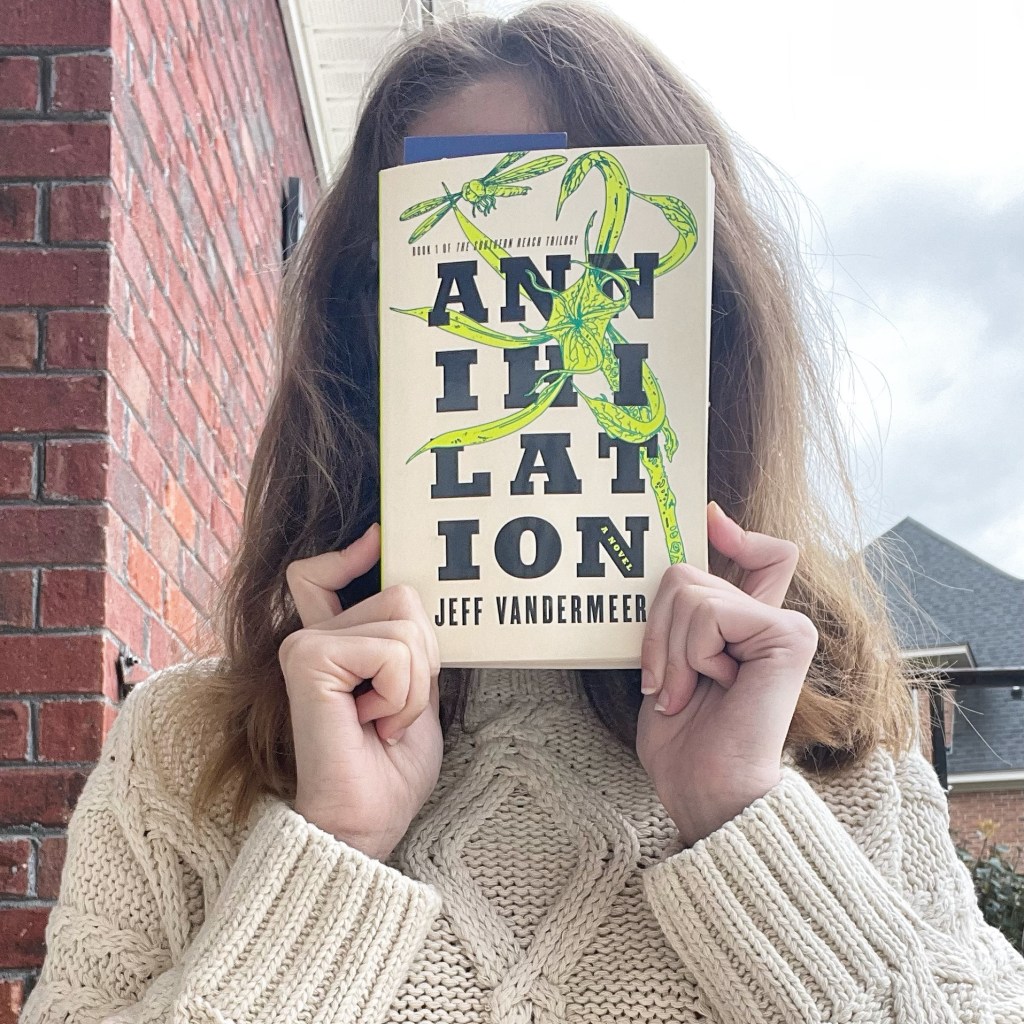
Area X has been locked away from the world for decades. Every few years, the Southern Reach Project send in a group of people to survey the land. Most of the time the expeditions do not make it back. This year, it is a group of four women who have to survey and map the terrain.
If you are like me, and character exploration is your favorite thing about reading, ‘Annihilation‘ will not be a book that you come out of loving. The way the character development is done by the author is very creative. We are never given a name of our narrator, as this is their account of their time in Area X, they are not supposed to get personal with the other team members. It was interesting but I never felt a strong connection with the narrator.
At first, I thought this atmosphere was going to be great because the nature writing was so good, but then I began to ask questions. Why is Area X a thing? What caused it? What is the outside world like? Is it a dystopian society or the world as we know it? We do get some answers but nothing in great detail. This book, as it is an account, would make sense if someone in the book universe was reading it but for someone in our real world it can be confusing. Other than that, the author did a great job at really putting the reader inside Area X.
The writing was my favorite part of Annihilation. As stated before, the nature writing is superb. We really get to see how lush but almost claustrophobic Area X is. If you are someone who enjoyed the writing of ‘Where the Crawdads Sing’, you will probably like the writing here even if the genres are completely different. This reads like a nonfiction as this is the character’s account of her time in the area. I really was not expecting that and it was something different for me in the science fiction genre.
On paper, the plot sounds like something I would enjoy. The character work was not there though, so therefore, I did not care what was happening to the characters and that meaning the plot became irrelevant to me.
If you are like me, and character exploration is your favorite thing about reading, ‘Annihilation‘ will not be a book that you come out of loving.The character development was done in an interesting form but I never felt a strong connection with the narrator. At first, I thought this atmosphere was going to be great because the nature writing was so good, but then I began to ask questions.Other than that, the author did a great job at really putting the reader inside Area X. The writing was my favorite part of Annihilation. I really was not expecting that and it was something different for me in the science fiction genre. On paper, the plot sounds like something I would enjoy. This was a good book but I am not rushing to pick up the next ones in the series.
3 out of 5 stars.
‘Owen’ Book Review
‘Owen’ is the story of a man who went from a Welsh solider in the English army, to a servant, and then ended up marrying the dowager queen of England. His descendants would go on to rule multiple countries around Europe. The founder of a great dynasty that would change England and therefore the world.
Owen Tudor is one of the people in the Wars of the Roses, that I have never seen portrayed in film or writing. That was until I read this book. I think it is quite strange that many have not ventured into writing about this man as in a sense he founded the Tudor Dynasty. The character work here is very one dimensional but I can see why since there is not a lot to base Owen on. I did like the portrayal of Queen Catherine and the dialogue that came along with that.
I have talked far and wide for my love of the Middle Ages and more specifically the Wars of the Roses time period. The author did a great deal of research on the time period and the people in it.
The writing is where I think this fell flat for me but it also could have been the plot but we will get to that. It was very mechanical and simple. Which does make for an easy read but I got bored with it. One dimensional is a word that I would use to overall describe my time reading ‘Owen’.
As stated before, it is obvious that the writer did his research for the first installment of the Tudor trilogy. That is great but it also held him back a lot. If you know the life of Owen Tudor that is exactly what you are going to get with very few moments going in depth or veering off course. It got dull and repetitive as the story went on.
The character work here is very one dimensional but I can see why since there is not a lot to base Owen on.The author did a great deal of research on the time period and the people in it. The writing was very mechanical and simple. The plot got dull and repetitive as the story went on. I did not hate this book or love it, I left it with no strong feelings therefore it will a receive a 2.5 star.
Five Star Predictions for 2023
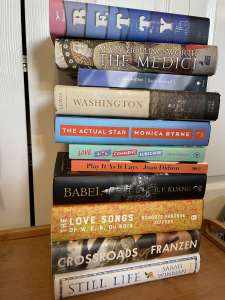
Here are the books that I plan to read this year, 2023, that I believe will be five stars. The best of the best. I will be leaving the description of each book below but I would like to say that these are copied from Goodreads and not personally written by me.
Betty –
So begins the story of Betty Carpenter. Born in a bathtub in 1954 to a Cherokee father and white mother, Betty is the sixth of eight siblings. The world they inhabit is one of poverty and violence–both from outside the family, and also, devastatingly, from within. The lush landscape, rich with birdsong, wild fruit, and blazing stars, becomes a kind of refuge for Betty, but when her family’s darkest secrets are brought to light, she has no choice but to reckon with the brutal history hiding in the hills, as well as the heart-wrenching cruelties and incredible characters she encounters in her rural town of Breathed, Ohio.
Inspired by the life of her own mother, Tiffany McDaniel sets out to free the past by telling this heartbreaking yet magical story–a remarkable novel that establishes her as one of the freshest and most important voices in American fiction.
Love, Pamela –
PAMELA ANDERSON’s blond bombshell image was ubiquitous in the 1990s. Discovered in the stands during a Canadian football game, she was quickly launched into superstardom, becoming Playboy‘s favorite cover girl and an emblem of Hollywood glamour and sex appeal. Yet the Pamela Anderson we think we know was created through happenstance rather than careful cultivation. Love, Pamela brings forth her true story: that of a small-town girl getting tangled up in her own dream.
Pamela forged ahead with grace, finding sanctuary in her love of art and literature, and emerged a devoted mother and activist. Now, having returned to the island of her childhood, after a memorable run starring as Roxie in Chicago on Broadway, Pamela is telling her story, a story of an irrepressible free spirit coming home and discovering herself anew at every turn. With vivid prose interspersed with bursts of original poetry, Love, Pamela is a pensive, layered, and unforgettable memoir.
The Medici –
Wealthy bankers, wise politicians, patrons of the arts, glittering dukes… so runs the traditional telling of the story of the Medici, the family that ruled Florence for two hundred years and inspired the birth of the Italian Renaissance.
In this definitive account of their rise and fall, Mary Hollingsworth argues that the idea that the Medici were wise rulers and enlightened fathers of the Renaissance is a fiction. In truth, she says, the Medici were as devious and immoral as the Borgias – tyrants loathed in the city they illegally made their own and which they beggared in their lust for power.
Ghostwritten –
A gallery attendant at the Hermitage. A young jazz buff in Tokyo. A crooked British lawyer in Hong Kong. A disc jockey in Manhattan. A physicist in Ireland. An elderly woman running a tea shack in rural China. A cult-controlled terrorist in Okinawa. A musician in London. A transmigrating spirit in Mongolia. What is the common thread of coincidence or destiny that connects the lives of these nine souls in nine far-flung countries, stretching across the globe from east to west? What pattern do their linked fates form through time and space?
A writer of pyrotechnic virtuosity and profound compassion, a mind to which nothing human is alien, David Mitchell spins genres, cultures, and ideas like gossamer threads around and through these nine linked stories. Many forces bind these lives, but at root all involve the same universal longing for connection and transcendence, an axis of commonality that leads in two directions—to creation and to destruction. In the end, as lives converge with a fearful symmetry, Ghostwritten comes full circle, to a point at which a familiar idea—that whether the planet is vast or small is merely a matter of perspective—strikes home with the force of a new revelation. It marks the debut novel of a writer with astonishing gifts.
Washington –
On January 24, 1791, President George Washington chose the site for the young nation’s capital: ten miles square, it stretched from the highest point of navigation on the Potomac River, and encompassed the ports of Georgetown and Alexandria. From the moment the federal government moved to the District of Columbia in December 1800, Washington has been central to American identity and life. Shaped by politics and intrigue, poverty and largess, contradictions and compromises, Washington has been, from its beginnings, the stage on which our national dramas have played out.
“It is our national center,” Frederick Douglass once said of Washington, DC; “it belongs to us, and whether it is mean or majestic, whether arrayed in glory or covered in shame, we cannot but share its character and its destiny.” Interweaving the story of the city’s physical transformation with a nuanced account of its political, economic, and social evolution, Lewis tells the powerful history of Washington, DC ” the site of our nation’s highest ideals and some of our deepest failures.
The Actual Star –
The Actual Star takes readers on a journey over thousands of years and six continents —collapsing three separate timelines into one cave in the Belizean jungle.
In each era, age-old questions about existence and belonging and identity converge deep underground. Because only in complete darkness can one truly see the stars.
Love, Comment, Subscribe –
Back in high school, Lily Wang wanted to be popular, but she considered herself lucky to be part of a tight group of oddballs and honors students called the Nerd Herd. Now, at twenty-eight, she feels like she’s finally on the cusp of succeeding as a beauty influencer—if she can hit five million subscribers, brands will take notice and she could get her own makeup line.
Fellow Nerd Herd alum Tobin Bui has had a lot of success as a YouTube gamer. But the road to online stardom has been rocky. First, he disappointed his parents by dropping out of college, and now, after years of pranks, skits, and playthroughs, he’s struggling to come up with new content to satisfy his ever-growing fan base. His agents say he needs cross-audience appeal, a new twist.
Play it as it Lays –
A ruthless dissection of American life in the late 1960s, Play It as It Lays captures the mood of an entire generation, the ennui of contemporary society reflected in spare prose that blisters and haunts the reader. Set in a place beyond good and evil – literally in Hollywood, Las Vegas, and the barren wastes of the Mojave Desert, but figuratively in the landscape of an arid soul – it remains more than three decades after its original publication a profoundly disturbing novel, riveting in its exploration of a woman and a society in crisis and stunning in the still-startling intensity of its prose.
Babel –
1828. Robin Swift, orphaned by cholera in Canton, is brought to London by the mysterious Professor Lovell. There, he trains for years in Latin, Ancient Greek, and Chinese, all in preparation for the day he’ll enroll in Oxford University’s prestigious Royal Institute of Translation—also known as Babel.
For Robin, Oxford is a utopia dedicated to the pursuit of knowledge. But knowledge obeys power, and as a Chinese boy raised in Britain, Robin realizes serving Babel means betraying his motherland. As his studies progress, Robin finds himself caught between Babel and the shadowy Hermes Society, an organization dedicated to stopping imperial expansion. When Britain pursues an unjust war with China over silver and opium, Robin must decide…
The Love Songs of W.E.B Dubois –
The great scholar, W. E. B. Du Bois once wrote about the Problem of Race in America, and what he called “Double Consciousness,” a sensitivity that every African American possesses in order to survive. Since childhood, Ailey Pearl Garfield has understood Du Bois’s words all too well. Bearing the names of two formidable Black Americans—the revered choreographer Alvin Ailey and her great grandmother Pearl, the descendant of enslaved Georgians and tenant farmers—Ailey carries Du Bois’s Problem on her shoulders.
To come to terms with her own identity, Ailey embarks on a journey through her family’s past, uncovering the shocking tales of generations of ancestors—Indigenous, Black, and white—in the deep South. In doing so Ailey must learn to embrace her full heritage, a legacy of oppression and resistance, bondage and independence, cruelty and resilience that is the story—and the song—of America itself.
Crossroads –
It’s December 23, 1971, and heavy weather is forecast for Chicago. Russ Hildebrandt, the associate pastor of a liberal suburban church, is on the brink of breaking free of a marriage he finds joyless–unless his wife, Marion, who has her own secret life, beats him to it. Their eldest child, Clem, is coming home from college on fire with moral absolutism, having taken an action that will shatter his father. Clem’s sister, Becky, long the social queen of her high-school class, has sharply veered into the counterculture, while their brilliant younger brother Perry, who’s been selling drugs to seventh graders, has resolved to be a better person. Each of the Hildebrandts seeks a freedom that each of the others threatens to complicate.
A tour de force of interwoven perspectives and sustained suspense, its action largely unfolding on a single winter day, Crossroads is the story of a Midwestern family at a pivotal moment of moral crisis. Jonathan Franzen’s gift for melding the small picture and the big picture has never been more dazzlingly evident.
Still Life –
Tuscany, 1944: As Allied troops advance and bombs fall around deserted villages, a young English soldier, Ulysses Temper, finds himself in the wine cellar of a deserted villa. There, he has a chance encounter with Evelyn Skinner, a middle-aged art historian who has come to Italy to salvage paintings from the ruins and recall long-forgotten memories of her own youth. In each other, Ulysses and Evelyn find a kindred spirit amongst the rubble of war-torn Italy, and set off on a course of events that will shape Ulysses’s life for the next four decades.
With beautiful prose, extraordinary tenderness, and bursts of humor and light, Still Life is a sweeping portrait of unforgettable individuals who come together to make a family, and a richly drawn celebration of beauty and love in all its forms.
 Izzy Reads