
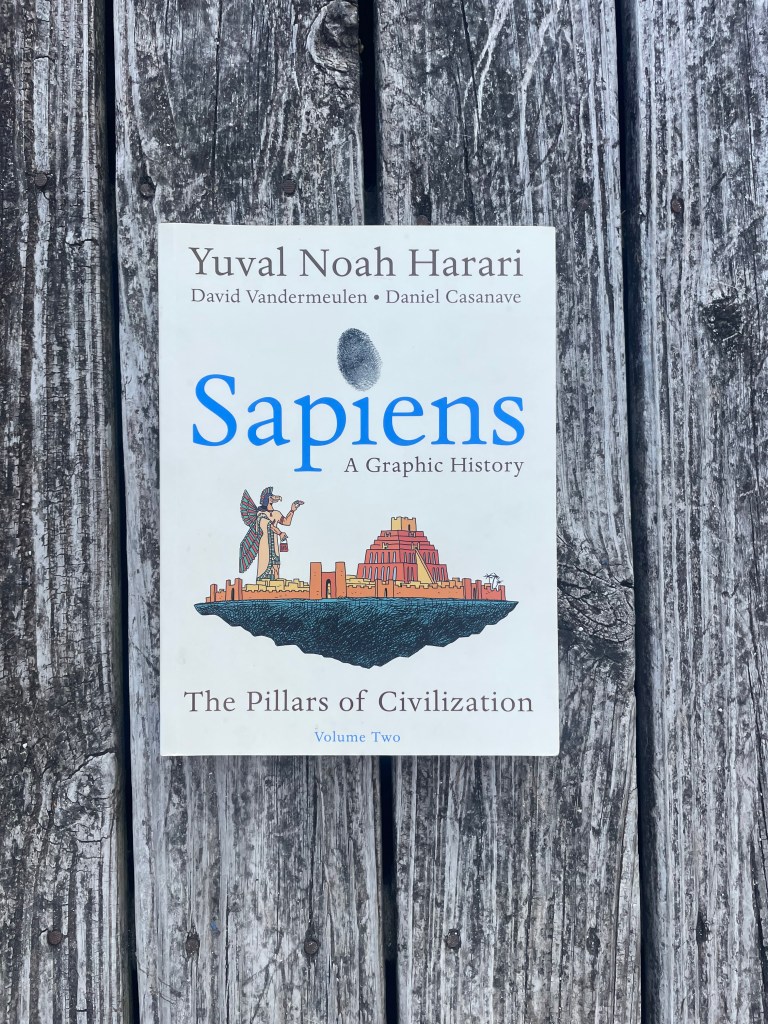
“What if humanity’s major woes—war, plague, famine and inequality—originated 12,000 years ago, when Homo sapiens converted from nomads to settlers, in pursuit of the fantasy of productivity and efficiency? What if by seeking to control plants and animals, humans ended up being controlled by kings, priests, and Kafkaesque bureaucracy? Volume 2 of Sapiens: A Graphic History–The Pillars of Civilization explores a crucial chapter in human development: the Agricultural Revolution. This is the story of how wheat took over the world; how an unlikely marriage between a god and a bureaucrat created the first empires; and how war, plague, famine, and inequality became an intractable feature of the human condition.”
This graphic adaptation has been a great refresher to the ideas from the original ‘Sapiens’ book. It has been a while since I read that one and I now have more knowledge under my belt making this an all new reading experience. This will be great for people who do not typically read nonfiction. It is casual in its witty style.
However, this was a lot of info coming at me fast. I’m scared that it might not have stuck in my brain. It also felt like the book was going over the same point over and over again. That pretty much everything is a man-made concept and being a human is biological, and our mind came up with everything else to keep order. By everything else I mean; government, money, religions, customs, romanticism, laws, all sorts of things. It needed to be diced down.
I never had much thought on the agricultural revolution, but so much and so many of our modern problems stem back to it. This book asked the question of if it was a mistake and in my personal opinion no it wasn’t because we wouldn’t be here without it and everything does happen for a reason and unfolds the way it is supposed to. This was a good book, but I don’t think it will work for everybody.
3 out of 5 stars.

