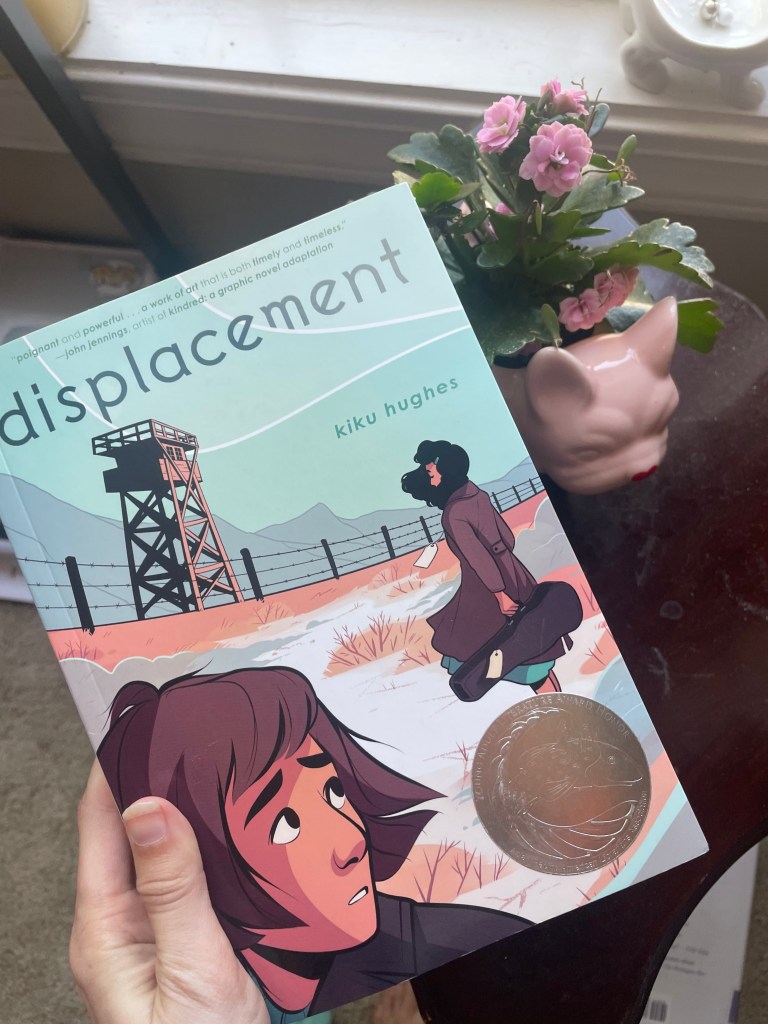
” “Displacement” by Kiku Hughes is a poignant graphic novel that intertwines the story of a modern-day Japanese American girl, Kiku, with the historical context of Japanese internment during World War II. When Kiku is transported back in time to a Japanese internment camp, she grapples with her family’s past and the trauma of displacement faced by her ancestors. Through her journey, she experiences the harsh realities of life in the camps, the impact of racism, and the struggle for identity, ultimately reflecting on the importance of remembering history and understanding the ongoing effects of systemic injustice. The narrative blends personal and collective memory, highlighting themes of resilience, belonging, and the fight against erasure.”
Each month, I like to add a graphic novel to my TBR, and this month it is ‘Displacement’ by Kiku Hughes. As a child, I read a ‘Dear America’ book on Japanese internment camps in the American West, but I haven’t read anything on it since. This is another work of young adult fiction that mixes fact and fiction. I love seeing these bits of history told in various forms—whether for adults, young adults, graphic novels, or memoirs. I think it’s so important to present history in as many formats as possible so it can be accessible to everyone.
The time travel elements are reminiscent of ‘Kindred’ by Octavia E. Butler, as we have a character going back for a little bit every now and then. It also reminds me of ‘One Italian Summer’ by Rebecca Serle, as we see our main character visiting a family member in the past when they were young. The big theme here is the importance of being educated on history, as history tends to repeat itself. These internment camps really need to be discussed more. I previously read about this subject, and we learned about it in school, but it needs to be more widely addressed.
World War II fiction is extremely popular, but it often focuses mainly on the European front. I believe the stories of Japanese Americans need to be spoken about more, as they endured significant injustices at the hands of the American government simply because of their ancestral background. I thought it was clever to use time travel in this book because Kiku is displaced from 2016 back to the 1940s, while the people of that time are being displaced from their lives and sent to these camps. Both have experienced displacement.
The author used this time travel element to cover gaps in her knowledge of her grandmother’s story. I do wish the glossary had been at the front of the book, as there were some terms I wasn’t familiar with, and I discovered the glossary was at the very back but once I had finished the book. One theme I found interesting was the struggle between trying to survive and doing the right thing, and how hard that choice can be. A quote that really captures this book is, “A memory is too powerful a weapon.” We have to remember history and how it shaped us because it tells the story of where humanity comes from and where it will go.
There were also things I had never heard of that I learned about in this book, like how Japanese Americans were portrayed as a model minority during the civil rights movement. Who knew that people in power were trying to pit other minorities against each other and spread anti-Black racism? This wasn’t the only time that camps were discussed in American history; while we hear about them today, back in the 70s, there were rumors and efforts to start camps to detain communists or Black Panthers.
I’d like to end with two more quotes. The first is, “Rumors start when there’s fear and a lack of information, and they still influence our memories forever.” The second is, “Never again is now.” So many times, we hear people say that we won’t allow things like concentration camps to happen again, but we really need to hold true to that as history progresses. This was a good book, and if you want to learn more about this time in American history and these atrocities, I recommend that you pick it up.

 Izzy Reads