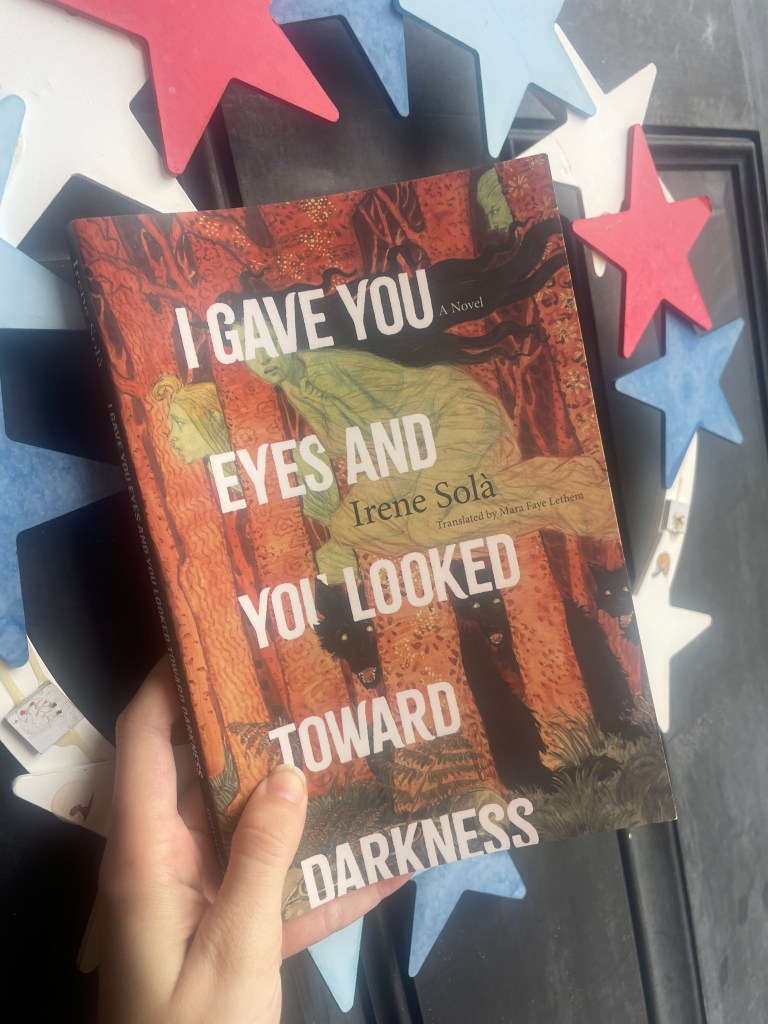
“I Gave You Eyes and You Looked Toward Darkness by Irene Solà is a haunting, polyphonic novel set within a single day in a remote Catalonian farmhouse called Mas Clavell, where a dying matriarch named Bernadeta lies surrounded by the spectral voices of her female ancestors . Spanning centuries, the narrative weaves together folklore, witchcraft, devil’s bargains, wars, and curses linked to a pact struck by Joana, an ancestor who traded her soul for a husband—only to discover he was physically imperfect, dooming her descendants to bear birth defects the-tls.com+5kirkusreviews.com+5ft.com+5. Through surreal time shifts and vivid, earthy storytelling, the novel explores the resilience, suffering, and defiant humor of women who have survived brutal histories, as ghosts and living voices echo the landscape’s darker legacies goodreads.com+3ft.com+3theguardian.com+3.”
I really enjoyed these characters, with Joana being my favorite. They are campy and quirky, but not in a cringe-worthy way; they almost remind me of the witches in “Hocus Pocus.” However, I want to remind you that this is a horror novel. While these women might be comedic and the story may have humorous moments, at any moment, things could snap and become creepy. It was fun to see how different bits of history, as well as the present, are reacted to by different generations.
We see these characters through all stages of life, and as I mentioned, they can be comedic or creepy, but they also have their flaws. They are all still people. These flaws can be mental or physical; they aren’t perfect characters. In fact, I would say they are quite imperfect, which makes them all the more enjoyable to read about because I never really knew what these women would do next.
The atmosphere was definitely my favorite part. This story feels so ancient; it seems like it could have been told around a fire pit hundreds of years ago, yet it could also be told in 2024 when it was published in English. It has that fairytale, folktale vibe, and I love that because there’s always something to be learned from that kind of story.
The writing is definitely unique. It’s somewhat confusing, and I found myself puzzled while reading at times. In some instances, this style is definitely an acquired taste. Normally, I’m not someone who enjoys descriptive, long, stream-of-consciousness writing; that’s typically not for me. However, when the book is less than 200 pages, I can manage it without issue.
Something I did notice about the writing, which might be attributed to translation, is that there were a lot of big words I wasn’t familiar with, which caused some confusion for me as well. However, I loved the allegories and metaphors used, especially at the start of a chapter where a house is used to describe the human body and how our souls and lives are contained within that body, with the body being the house for our soul. I know that sounds confusing as I worded it now, but it’s truly incredible to think about.
There are a lot of themes in this book that are prevalent, such as motherhood, religion, and the powerful influence of religion itself. You really have to be careful about how you approach and handle these themes, as you could end up cursing your legacy and everyone who comes after you. However, I think the main theme here is that everything in life has blurred lines. Reality is a blurred line. Before I read the book, I didn’t check the back cover, but this sentence on it describes the story perfectly: “A novel in which the line between the dead and the living, past and present, story and history are blurred. In it, Irene Sola draws on oral tradition as well as art, literature, and fairytales to tell a completely new kind of story.” This description captures the essence of the book perfectly. Irene Sola hit the nail on the head with that.
If that was the kind of book she aimed to write, then it’s a perfect description. We would not be here in the present if it weren’t for history, and history wouldn’t be history if it weren’t for the present. This book felt like a fever dream, and while it can be a lot to take in at the moment, as I’ve done with her other work, the more I think about it, the more I realize how impactful and thought-provoking the author’s work can be.
Now, would I recommend this book? Yes, I would. I’d like to do some comparisons: if you like this book, then you might enjoy works by authors like Mona Awad or Otesha Moshfegh, as they often explore themes of “weird girl” literature. This book made me realize that if bodily fluids and bodily functions are a part of the narrative, it’s probably going to be a “weird girl” book. For other books that remind me of “Northwoods” by Daniel Mason, which explores how a plot of land holds so much history and influences the ambiance around it, I also think of the iconic classic “One Hundred Years of Solitude.” The village in that novel reminds me so much of the house in this book, with all the little mystical things happening to the family.
Yes, I really did enjoy this book from one of my favorite authors.
3.75 out of 5 stars

 Izzy Reads