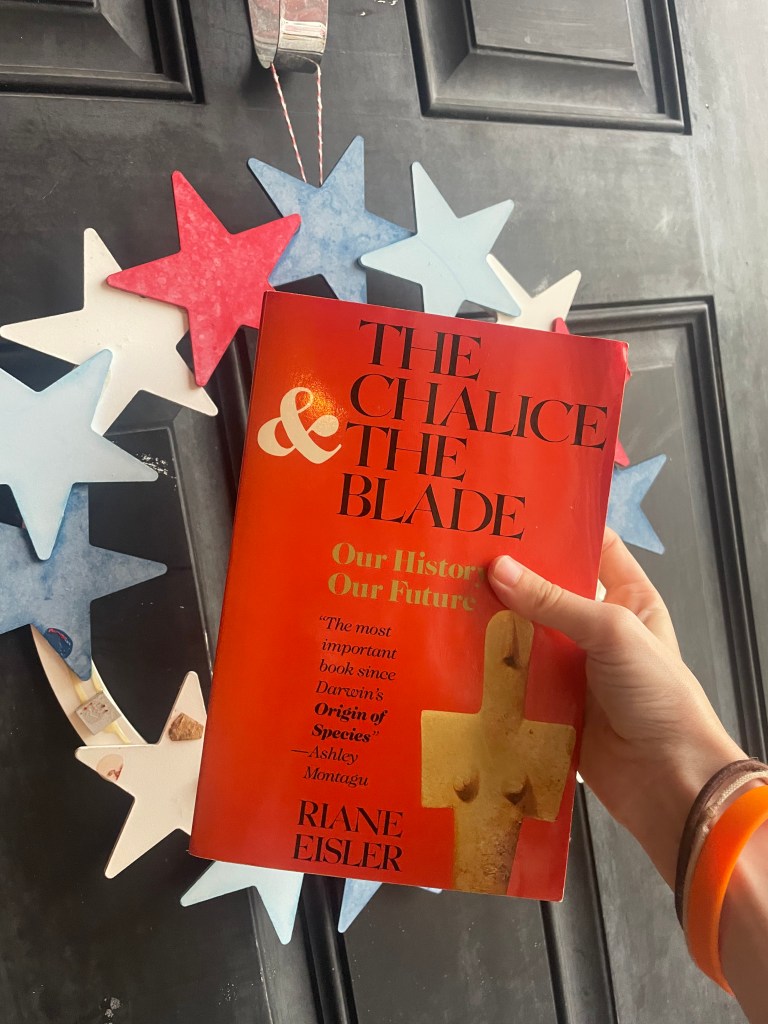
“The Chalice and the Blade: Our History, Our Future by Riane Eisler offers a sweeping re-interpretation of human cultural evolution by contrasting two fundamental social models: the equitable, nurturing partnership societies symbolized by the chalice, and the authoritarian, violent dominator societies represented by the blade . Drawing from archaeology, anthropology, history, religion, and social sciences, Eisler proposes that early human societies—especially in Neolithic Europe—were organized around life-affirming, gender-egalitarian values (gylany), before being overtaken by patriarchal structures featuring hierarchy, violence, and oppression . Rather than presenting utopia, the book argues that partnership-based social systems are deeply rooted in our past and offer viable pathways for building more peaceful, sustainable futures. It concludes with two divergent visions for society’s trajectory: one continuing on a dominator course, the other reclaiming partnership values for healing and transformation.”
This book was like a lightbulb moment for me. It confirmed and deepened my beliefs about society, where we came from, and how religion developed in the Paleolithic and Neolithic times. Archaeological evidence seems to suggest that these early societies were egalitarian, where everyone was treated equally, with no one group dominating others .It isn’t to show that egalitarian societies are perfect. They don’t have as much war and bloodshed but they still have their issues. There is no perfect societal structure but this system has seemed to prove more beneficial throughout history.In Europe’s first civilization, the Minoans on Crete, we see a lot of evidence pointing in that direction, and I became really fascinated by Crete after reading this book.
To take it back a few thousand years, men from the outskirts of society banded together through violence. They were the ones who worshipped gods of lightning bolts and hammers, raiding these egalitarian societies. The world chose to respond to violence with violence, and it has been that way ever since. We now live in a society where there has to be a dominator, someone at the top. This book dives into how that happened and discusses various instances in history of how this has been enforced and how it continues today. I also learned how history has cycles. At one point women might come close to being equals with men and then have a fall. A historical example would be Elizabethan England, a queen on the throne and men being able to show more femininity in the likes of Shakespeare. After that time we see the Puritans and witch trials. I cannot help but see it where we are now. During the sixties we saw a societal revolution mainly stemming from the Vietnam War. Now, women’s rights are being taken in the form of body autonomy and abusers having no real punishment.
Originally published in 1987, I was concerned because so much has happened since the late 1980s. Luckily, I was reading this on my Kindle, which included an epilogue written by the author in April 2017, and she was still addressing the same societal issues I had been thinking about. After reading this book, I found it refreshing to see the same concerns echoed. This book showed the evolution of religion and how society has viewed the role of women.
Why am I not giving it a five-star rating? It starts with a 26-page introduction that basically explains what every chapter will cover, which was a lot of information to absorb. Some of it went right over my head, making it challenging to take in, especially since I wasn’t familiar with much of this material before reading. The book does become easier to read as it progresses, but I will admit some parts still went over my head. I would highly recommend having a dictionary on hand or reading it on Kindle, as there are terms I wasn’t familiar with. Fortunately, on Kindle, I could hold down a word to see its definition, which was very beneficial for me.
A lot of this has me questioning who writes history, what makes it into the history books, and what is taught in the classroom. I wonder why certain aspects are not discussed or are not confirmed, even if they seem believable to me. That raises a whole other can of worms I will be pondering for a while. Overall, this book was so thought-provoking and eye-opening, and yes, I would highly recommend that you pick it up!
4 out of 5 stars.

 Izzy Reads