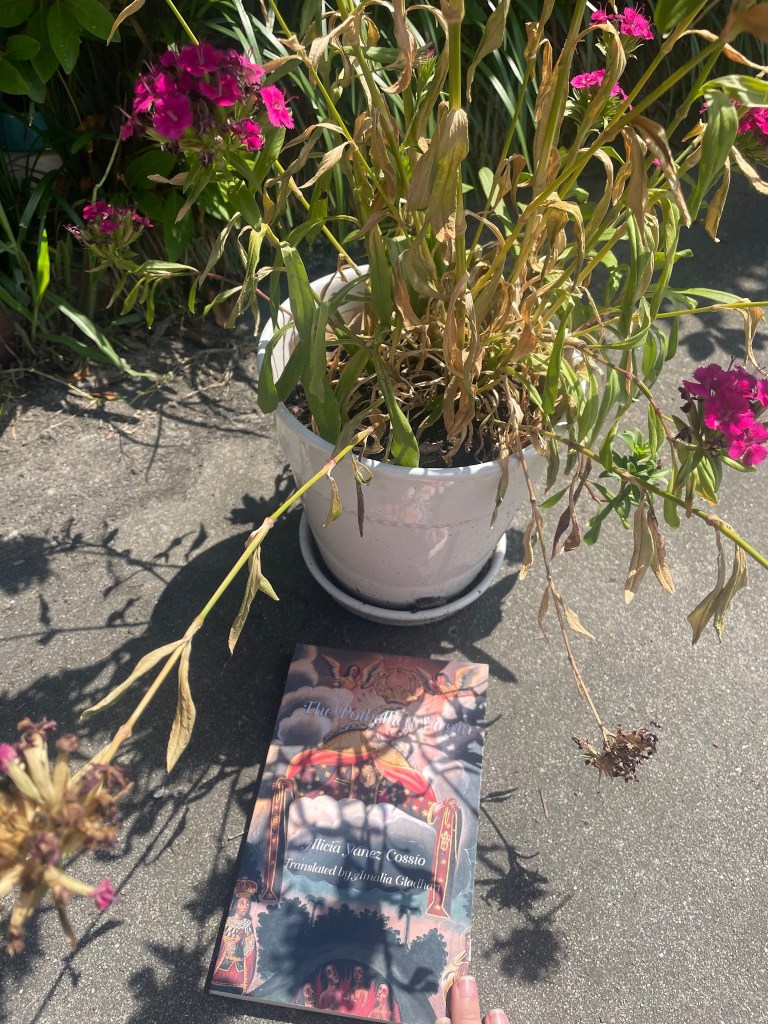
“In an unnamed town in the Ecuadorian Andes, a small wooden icon—La Virgen Pipona (the Potbellied Virgin)—conceals the documents that define the town’s social history. That history recently has been dominated by the women of the Benavides family, a conservative clan and, not coincidentally, the caretakers of the Virgin. Their rivals are the Pandos, a family led by four old men who spend their days smoking in the park across from the Virgin’s cathedral and offering revisionist versions of local and national events. When a military skirmish threatens the Virgin (and the secret in her famous belly), the Benavides women must scramble to preserve their place as local matriarchs—without alerting the old Pandos to the opportunity that might enable them to finally supplant their rivals.” – Description from Amazon.
This short little book might be small, but there is a very large cast of characters and we are introduced to them rather quickly. I had a hard time keeping track of who is who, especially with this being about two feuding groups of people who share the same last names. They got to be a bit interchangeable. The sisterhood and the Benavides family, I really wanted to explore more of their relationship dynamics with one another, but that is not prevalent in this book. Doña Carmen is the only distinguishable character and I did enjoy her as a character. She’s one of my favorite kinds of people if she sees something that needs to be done. She’s going to go off there and do it.
The atmosphere is quite different from a lot of popular books. This is taking place in the Andes in Ecuador. The tone is very fairytale-esque with folktale vibes. There is nothing magical about this story but by the way it is told it feels like it could be one of those two things. At the start, there is a lot of world building and info dumping with that. I read the introduction of the book and that told me a lot about Ecuadorian history and culture, but then we would get basically the same thing told to us in the book and that made it overbearing, and I don’t think it was necessary for the story.
The writing style is long-winded with paragraphs that go on for pages. I had a really hard time following the story. It isn’t dialogue heavy. We would get maybe two lines of dialogue every couple of pages.
The author is very creative with how she handled this plot. This is a story of the impact that colonization and colonialism have on the modern world. She takes two families and personifies European colonizers and indigenous peoples of Latin America. There’s a fight between who gets to tell history; those are some great themes. I really wish I connected with the book more. The author even dives into what it was like for an isolated community in the last century, seeing all the rapid changes of our modern day and age and how the smaller rural communities evolve, even if it is slow.
I was confused for a lot of this book, but I also want to have a disclaimer that I did start this book while having a migraine and I wouldn’t recommend doing that. It was a disservice to the author and the work of fiction. I do plan to reread this book at a later date and hopefully it will work out better for me then as it didn’t do a whole lot for me this time around.
2.25 out of 5 stars.


